May 9, 2026 • Elena Garcia • 10 min reading time • Specs verified June 25, 2026
Thermal Foggers from $200 to $3,300: Pulse-Jet vs. Electric Heat, and When the Price Jump Is Worth It
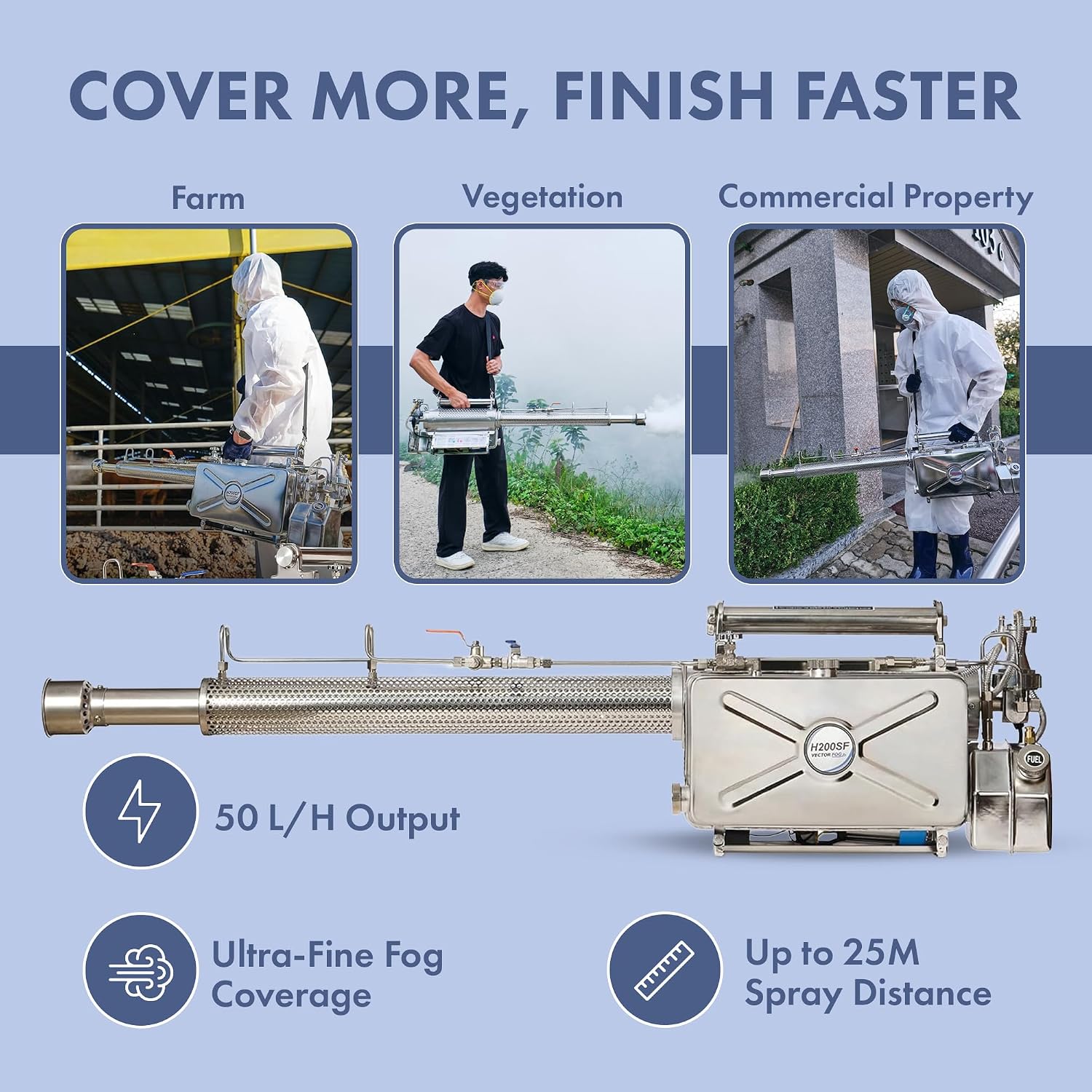
A thermal fogger is exactly what it sounds like: a machine that heats a liquid — typically a diluted pesticide or disinfectant — until it vaporizes into a dense, visible cloud of microscopic droplets. That cloud drifts into hiding spots, canopy layers, and structural voids that a spray gun simply cannot reach. If you’ve ever seen a municipal mosquito-control truck pumping white smoke down a neighborhood street at dusk, you’ve seen a large-scale thermal fogger at work. For commercial pest-control operators, greenhouse managers, and serious backyard applications, a personal or truck-mounted thermal unit delivers the same physics at a smaller scale. This guide compares the two dominant heating technologies — pulse-jet (a combustion-driven heat exchanger borrowed from early jet engine design) and electric heat (a resistance-heated coil powered by a battery or AC outlet) — across five price bands from roughly $200 to $3,300, and gives you a direct decision rule for each one.
If you’re holding a contract renewal, scaling a route, or speccing a greenhouse operation right now, the technology choice matters more than the brand name on the handle. Here’s how to think about it.
| EDITOR'S PICK[H200SF-SS Thermal Fogger Machin…](https://www.amazon.com/dp/B01MQKOAT8?tag=greenflower20-20) | Mid-tier[H100SF Mid-Size Thermal Fogger…](https://www.amazon.com/dp/B00UXMGJMS?tag=greenflower20-20) | Budget pick[ODORx Thermo 55 Cherry Solvent-…](https://www.amazon.com/dp/B07W4M5NQK?tag=greenflower20-20) | |
|---|---|---|---|
| Heating Type | Electric | Battery | — |
| Tank Capacity | 6.5L | — | — |
| Material | Stainless Steel | — | — |
| Portable | ✓ | ✓ | — |
| Voltage | 110V | — | — |
| Price | $1,199.99 | $949.00 | $109.00 |
| See on Amazon → | See on Amazon → | See on Amazon → |
How the Two Technologies Actually Work (and Why It Changes Everything Downstream)
Pulse-jet thermal foggers use a resonant combustion chamber — running on gasoline or diesel — to generate rapid pressure pulses that heat a stainless-steel or aluminum fogging tube to temperatures between 550°F and 850°F (290°C–455°C). The formulation is metered into that tube through a calibrated jet, flash-vaporizes, and exits as a fog. The characteristic sound is a loud, rapid staccato — operators compare it to a motorcycle without a muffler. The key mechanical virtue: no external power source, high sustained output (typically 10–20 gallons per hour on commercial units), and a heat exchanger that can run for hours. The key liability: that combustion heat is indiscriminate, and not all active ingredients or carrier solvents survive the thermal spike intact.
Electric-heat thermal foggers pass formulation over a resistive heating element — usually nichrome wire or a ceramic block — that operates at much lower and more controllable temperatures, typically 300°F–450°F (150°C–230°C). They’re quieter, lighter (most fall under 8 lbs), draw from an 18V battery pack or standard AC outlet, and let operators dial in heat more precisely. The tradeoff: flow rates are substantially lower (usually 1–6 gallons per hour), and runtime on battery-only units is limited.
For the practitioner, this maps to a core decision axis: throughput versus formulation flexibility. Pulse-jet wins on throughput. Electric wins when your chemistry is temperature-sensitive, when you need quiet operation (food plants, healthcare facilities, hospitality venues), or when portability and indoor use are requirements.
Five Price Tiers: What You Get and What You Give Up
Tier 1: $150–$350 — Entry Electric (Homeowner / Light Commercial)
Units in this range — typified by the Burgess 1443 and similar propane-heated backyard models — are technically thermal foggers in that they vaporize an oil-based formulation, but they’re more accurately described as consumer vaporizers. Propane-heated versions heat a small metal nozzle to produce a short-range fog adequate for a residential yard. Electric models in this band, like several Hudson-branded units, run off AC and output 1–3 gallons per hour.
Published specs on this tier show oil reservoir capacities of 32–40 oz, fog output lasting 10–15 minutes per fill, and droplet size (VMD — volume median diameter, the size at which half the spray volume is in larger drops and half in smaller) typically in the 10–30 micron range — acceptable for open-air mosquito knockdown but marginal for canopy penetration.
The honest ceiling: PCT Magazine’s equipment-selection guidance for thermal fogging in vector control explicitly notes that consumer-tier thermal units lack flow-rate calibration and pressure regulation, which makes pesticide label compliance difficult to verify on a per-acre basis. If you’re writing service tickets and need documented application rates, this tier creates liability exposure.
Buy here if: You’re a homeowner or very small-lot operator treating your own property for personal use, and coverage consistency is a secondary concern.
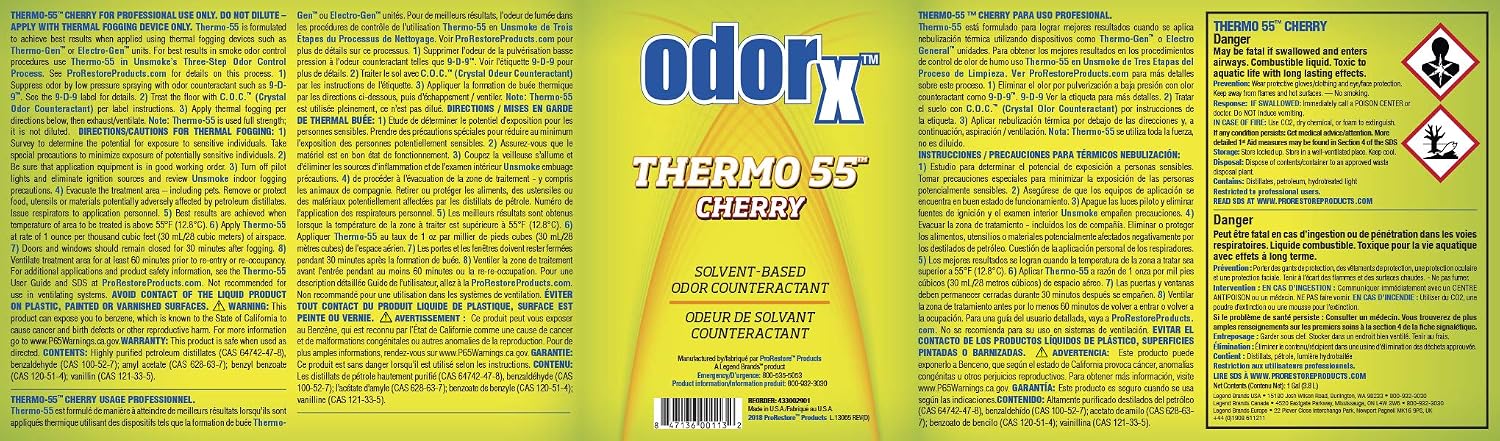
ODORx
$109.00
In stock on Amazon
Check price on AmazonTier 2: $350–$700 — Entry Professional Electric (Light Route Work, Greenhouse Spot Treatment)
This is where calibrated electric thermal foggers begin. The Vectorfog C100 Plus (spec-sheet rated at approximately 4 gallons per hour, 110V AC) and comparable units from Hudson’s commercial line sit here. Droplet VMD on published data typically lands between 5–15 microns for oil-based formulations — genuinely effective for indoor vector control, enclosed greenhouse bays, and spot treatments in food-handling facilities.
Battery-powered variants — the Vectorfog C150 Plus uses an 18V lithium platform — extend portability meaningfully. Operators in aggregated long-run reviews consistently flag the quiet operation and compatibility with water-based formulations as the differentiating value versus pulse-jet alternatives.
Chemical compatibility note: University of California Cooperative Extension pest-management guidelines (Application Equipment for Public Health Use) recommend confirming that thermal fogging formulations are rated as “fog-ready” — meaning they contain a carrier oil or emulsifier stable at operating temperatures. Water-based concentrates not formulated for thermal application will produce inconsistent particle size and potential active-ingredient degradation at the heater coil. This applies at every price tier, but practitioners switching from cold fogging to thermal work most commonly encounter the incompatibility here.
Buy here if: You’re doing indoor route work (restaurants, warehouses, apartments), need water-based formulation compatibility, or are adding a thermal unit to complement an existing ULV fleet without committing to pulse-jet fuel logistics.

H100SF
$949.00
In stock on Amazon
Check price on AmazonTier 3: $700–$1,400 — Mid-Tier Pulse-Jet (High-Throughput Outdoor Route Work)
Entry pulse-jet commercial units — the Pulsfog K-10 and comparable Igeba TF-35 sit near the lower boundary of this range — change the economics of outdoor vector control routes. Manufacturer-rated output for units in this class runs 8–12 gallons per hour, with fog range on published specs of 25–40 feet under calm conditions. Fuel consumption on a Pulsfog K-10 runs approximately 0.4–0.5 liters of unleaded per hour; operators covering large parks, campgrounds, or golf courses consistently report per-acre treatment times that are 3–5× faster than electric-tier units.
The pulse-jet heat spike (550°F–700°F range in this class) means you need pulse-jet-rated, oil-based formulations. The EPA’s Pesticide Registration Notice 2002-1 — Regulations for Thermal Fog Application of Pesticides — requires that pesticide labels specifically authorize thermal fog application. Not all products carry that authorization, and the high-heat environment can degrade certain synthetic pyrethroids if carrier ratios are off. Confirm label language before building a treatment protocol around any specific formulation.
Noise is a genuine operational constraint. Published dB ratings for units in this class typically range 85–95 dB at 3 meters — lawnmower-to-chainsaw territory. Municipal contracts increasingly carry nighttime noise ordinances that restrict pulse-jet operation to daytime hours in residential zones.
Side-by-side at the Tier 2 / Tier 3 crossover:
| Metric | Electric (Tier 2) | Pulse-Jet (Tier 3) |
|---|---|---|
| Flow rate (mfr-rated) | 3–5 gal/hr | 8–12 gal/hr |
| Fuel / power | 18V battery / 110V AC | Unleaded gasoline |
| Noise (approx.) | 55–65 dB | 85–95 dB |
| Indoor use | Yes | No |
| VMD range | 5–15 µm | 8–25 µm |
Buy here if: You have outdoor contracts covering multiple acres per visit, fuel logistics are manageable, and throughput per operator-hour is the primary economic constraint.
H100SF
$949.00
In stock on Amazon
Check price on AmazonTier 4: $1,400–$2,200 — Professional Pulse-Jet (Truck-Adaptable, High-Volume Route Work)
The Pulsfog K-22 and Igeba TF-65 represent this tier — larger fuel tanks (1.5–3L), higher hourly throughput (12–18 gal/hr rated), and reinforced heat exchangers designed for multi-hour continuous operation. Operators running mosquito abatement contracts for municipalities or large resort properties consistently point to the total-cost-of-ownership case: at 15 gallons per hour versus 4 gallons per hour, a 4-hour evening treatment that requires one operator and one machine at Tier 4 might require three electric units and two operators to cover equivalent acreage.
Part availability in this tier is meaningfully better than consumer-adjacent units. Pulsfog GmbH’s North American distributor network — documented in Pulsfog’s Pulse-Jet Technology Technical Overview, 2024 edition — maintains stocking of combustion tubes, check valves, and fogging jets for units going back 10+ years. That parts-ecosystem depth is a spec-relevant fact when you’re making a 5-year amortization decision on capital equipment.
Buy here if: You have outdoor contracts covering 5+ acres per treatment cycle, you run routes that justify the fuel logistics, and you need a machine that can be adapted for truck or ATV mounting.
H200SF-SS
$1,199.99
In stock on Amazon
Check price on AmazonTier 5: $2,200–$3,300+ — Flagship Commercial Pulse-Jet (Fleet Anchor, High-Cycle Reliability)
The Pulsfog K-30 and Igeba TF-95 anchor the top of the hand-carried thermal fogger market. Published specs show throughput of 18–22 gallons per hour and heat exchanger construction rated for 500+ operating hours before major service. The Vectorfog T150 series — documented in Vectorfog’s C150 Plus and T150 Series Specification Sheets (commercial product documentation, 2025) — bridges electric and combustion technologies in a backpack format and also appears in this tier for operators who prioritize formulation flexibility over maximum throughput.
The marginal performance gain from Tier 4 to Tier 5 is real but incremental. You’re buying durability cycles, serviceability infrastructure, and (on flagship Pulsfog units) factory-calibrated flow control that simplifies pesticide label compliance documentation. For a pest-control business running one or two units, the upgrade from Tier 4 is hard to justify on throughput alone. For a company managing a fleet of 5–10 machines where one down unit stalls a contract, the reliability margin and parts ecosystem change the math.
Buy here if: You operate a multi-machine fleet, contract SLAs depend on zero unplanned downtime, and the cost of a stalled treatment night exceeds the price difference between tiers.
H200SF-SS
$1,199.99
In stock on Amazon
Check price on AmazonThe Decision Rule
If your application is primarily indoor, involves temperature-sensitive chemistry, or requires quiet operation: Electric thermal is your tier. Budget Tier 2 for route work; hold Tier 1 for personal-use backup only.
If your application is outdoor, large-acreage, and petroleum-formulation compatible: Pulse-jet from Tier 3 upward. The throughput-per-dollar case becomes unarguable at scale. Move from Tier 3 to Tier 4 when your contracts justify a second machine or when you need truck-adaptable output. Move from Tier 4 to Tier 5 when fleet reliability and parts-ecosystem longevity are a genuine operational risk factor, not just a nice-to-have.
The jump that almost never pays off: Tier 1 to Tier 2 for a commercial operator who skips it entirely and tries to use a consumer unit on paid service work. PCT Magazine’s application-equipment guidance makes this point clearly: the liability exposure from an undocumented application rate on a public-health pest-control ticket outweighs the hardware savings by a wide margin. If you’re writing service records and billing by the acre, start at Tier 2 minimum — the calibration and formulation compatibility features are regulatory necessities, not luxuries.
A note on formulation safety at every tier: The National Pesticide Information Center (NPIC), operated by Oregon State University in cooperation with the EPA, maintains a formulator-facing database of thermal-fog-compatible products and carrier recommendations. Confirming that your chosen active ingredient is cleared for thermal fog application on its registered label — and that your carrier-to-concentrate ratio falls within the manufacturer’s operational temperature window — is not optional at any price point.
One note on current market conditions: supply-chain normalization has pulled lead times on Pulsfog and Igeba units back to 2–4 weeks from North American distributors, versus the extended waits that characterized earlier years. That removes one of the practical arguments for over-buying into a higher tier as an availability hedge — buy for the application, not the safety stock.