June 10, 2026 • Elena Garcia • 9 min reading time • Specs verified June 25, 2026
Reptile Terrarium Misting Systems: Matching Output, Droplet Size, and Timer Control to Your Species' Needs
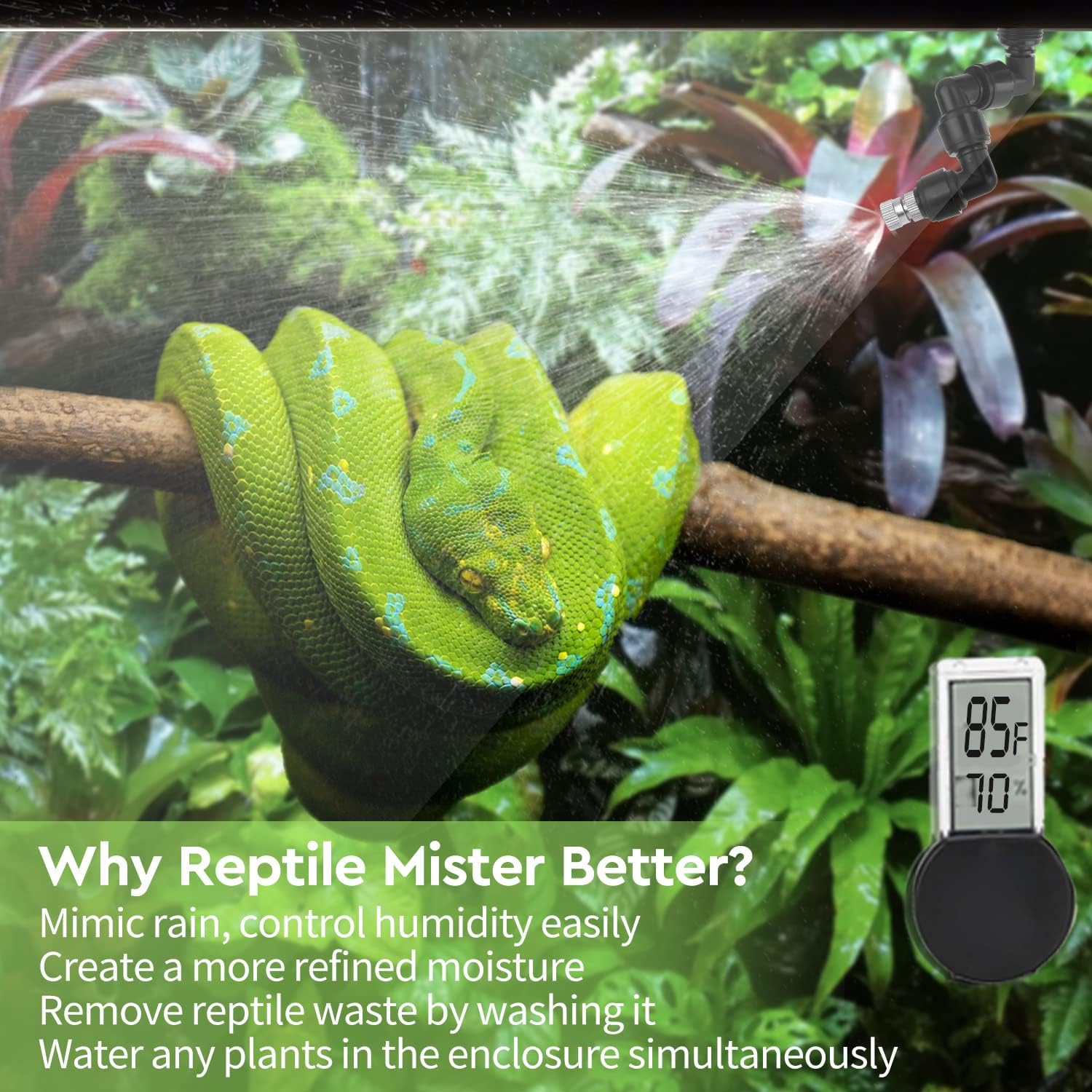
If you’ve ever watched a chameleon lean into a fine mist like it just found water in a desert, you understand why getting this right matters. Reptile terrarium misting systems are exactly what they sound like: automated devices that spray water into an enclosure on a timed schedule to maintain humidity — the amount of moisture in the air — at the level a given species needs to thrive. Get the humidity too low and many species develop respiratory problems, failed sheds, and chronic stress. Get it too high, and you invite bacterial infections, scale rot, and mold that can kill an animal quietly over weeks. The equipment sitting between those two bad outcomes ranges from a $30 manual hand-pump to a $400 programmable dual-nozzle rig with reservoir monitoring. This guide breaks down the three variables that actually determine whether a misting system works for your setup — output volume, droplet size, and timer resolution — and gives you a clear decision framework for matching hardware to the species on your care sheet.
Why “One Mister Fits All” Is a Myth
Walk into any well-stocked reptile supply retailer and you’ll find misting products marketed with language like “works for all tropical species” or “universal humidity solution.” That framing obscures a real mechanical problem: a single nozzle configuration cannot simultaneously produce the fast-evaporating micro-droplets a chameleon needs for drinking stimulation and the heavier, wetter spray a red-eyed tree frog needs to saturate cork bark.
The core tradeoff is between droplet size (measured in microns, VMD — volume median diameter, meaning half the spray volume falls above this size and half below) and penetration vs. evaporation rate. Smaller droplets — in the 5–30 micron range typical of ultrasonic humidifiers — stay suspended longer and raise ambient RH (relative humidity) efficiently, but they don’t provide visible water droplets on leaves and glass for animals that drink by licking surface water. Larger droplets — 80–200+ microns from a standard pump-pressure nozzle — wet surfaces and create visible drinking points, but they drain humidity faster and can oversaturate substrates (the bedding material on the enclosure floor) if misting frequency is too high.
Per G. Köhler’s Diseases of Amphibians and Reptiles, chronically wet substrate is one of the leading environmental contributors to bacterial dermatitis and respiratory infections in captive reptiles — making over-misting with large-droplet systems a genuine health risk, not just a cosmetic nuisance.
The second dimension that gets underweighted is timer resolution: how precisely you can control when and how long the system runs. A system with only a mechanical 15-minute interval timer is structurally incapable of supporting the 12-second burst cycles that help chameleons recognize and drink surface water without pooling the enclosure floor.
The Three Variables You’re Actually Buying
1. Output Volume and Reservoir Capacity
Output is typically rated in ml/minute or total ml per cycle. For a standard 18×18×36 inch arboreal (tree-dwelling) enclosure, a burst of 40–80ml every 4–6 hours is a reasonable starting range for species like veiled chameleons — though local ambient humidity, ventilation rate, and the hygroscopic (moisture-absorbing) properties of your substrate all shift that number.
By the numbers:
| Enclosure footprint | Recommended burst volume | Misting frequency (tropical species) | Reservoir minimum |
|---|---|---|---|
| 18×18×24 in | 20–50 ml | 2–3× daily | 0.5–1 L |
| 18×18×36 in | 40–80 ml | 2–4× daily | 1–2 L |
| 24×24×48 in | 80–150 ml | 3–5× daily | 2–4 L |
These ranges are synthesis estimates from husbandry literature including Ball’s Humidity in Reptile Husbandry and keeper consensus documented in Practical Reptile Keeping; they are not tested outputs from specific commercial products.
Reservoir capacity matters more than most buyers expect. A 1-liter reservoir running 4 cycles per day at 80ml per cycle is running dry every three days — fine for a single-enclosure keeper, but an operational liability if you’re managing a rack of enclosures or traveling. Entry-level systems from brands like Exo Terra and Zoo Med (specifically the Repti Rain and ReptiMist product lines) typically ship with 0.5–1L reservoirs. Purpose-built programmable systems like the Mistking Starter and Ultimate, the Cli-Mate Dual, and the Reptile Basics Timer-Controlled Misting System allow reservoir scaling to 5–20L external containers — a meaningful TCO (total cost of ownership) improvement if your collection is larger than three or four enclosures.
2. Droplet Size: Matching VMD to Species Biology
This is the specification reptile keepers almost never see on a product page, which is part of why mismatches are so common. Here’s a workable rule of thumb based on the literature:
Species that drink from surface droplets (chameleons, many geckos including day geckos, dart frogs in bioactive setups): You need a pump-pressure system producing larger droplets in the 80–200 micron VMD range. The visible bead of water on a leaf or glass panel is the drinking cue. Ultrasonic foggers — which produce a cool mist in the 1–10 micron range — raise RH but don’t stimulate drinking behavior in these animals. The Merkers’ Chameleons: Nature’s Hidden Jewels is explicit on this point: veiled and panther chameleons in captivity typically require visible surface water to initiate drinking, and invisible humidity increases alone are frequently insufficient.
Species that absorb moisture transdermally or require sustained high ambient RH (red-eyed tree frogs, many salamanders, high-humidity boas and pythons in bioactive enclosures): Ultrasonic foggers or fine-mist systems in the 10–50 micron range work well here, provided substrate drainage prevents pooling. These animals benefit from the prolonged suspension time of small droplets.
Desert and semi-arid species (leopard geckos, bearded dragons, blue-tongued skinks): Most do not need a misting system at all for ambient humidity; localized humid hides with a damp substrate insert are generally more appropriate. S. Rainford’s analysis in Practical Reptile Keeping notes that automated misting in desert enclosures is one of the more common husbandry errors in keeper communities — the convenience of automation can override the species’ actual environmental requirements.
Pump-pressure systems (like the Mistking line, Cli-Mate, and the Exo Terra Monsoon RS400) generate operating pressure in the 40–80 PSI range through an electric diaphragm pump, which produces a true misting spray. Ultrasonic units (like the Zoo Med Repti Fogger and various generic ultrasonic foggers) use vibration to aerosolize water into micro-droplets — different physics, different droplet profile, different application.
3. Timer Resolution and Programmability
This is the variable that most clearly separates consumer-grade systems from purpose-built reptile hardware — and it’s where spending more genuinely changes outcomes.
Mechanical interval timers (typically bundled with budget misters): Minimum cycle increments of 15–30 minutes. Adequate for high-humidity species that need sustained ambient RH maintenance but structurally unable to produce the short-burst cycles that support chameleon drinking behavior or the staggered multi-enclosure scheduling a collection keeper needs.
Digital countdown timers with multi-cycle programming: Units like the Mistking Ultimate controller and the Cli-Mate allow independent programming of ON duration (seconds, not just minutes) and OFF interval. This opens the door to 15-second bursts every 3 hours — the pattern that most closely mimics a tropical rain event — rather than the sustained 5-minute soaking that low-resolution timers force on you.
Smart/app-controlled systems: A small but growing category, including some configurations of the Reptile Basics system and third-party smart outlet integrations. Owners consistently report that app scheduling reduces the friction of seasonal adjustments — chameleons, for instance, benefit from extended dry periods in winter months to simulate seasonal variation, a pattern that’s cumbersome to implement with a physical timer dial.
The decision rule here is straightforward: if your species requires drinking stimulation (chameleons, many agamids, some geckos), the minimum viable hardware is a pump-pressure system with second-level timer resolution. Budget systems without this capability are not a cheaper version of the right solution — they are a categorically different, often inadequate one.
Chemical Compatibility and Water Quality Considerations
Reptile misting systems are almost exclusively running tap or RO (reverse osmosis, a filtration method that removes dissolved minerals) water, but this doesn’t make compatibility a non-issue. Hard tap water — high in calcium and magnesium — creates mineral scaling in nozzles and pump heads that progressively degrades spray quality over 3–6 months of daily use. Owners running tap water consistently report nozzle clogging as the primary failure mode across mid-range pump systems.
The practical implication: if your tap water is hard (above ~150 ppm TDS — total dissolved solids — easily measured with a $10 meter), budget for either an RO source or a citric acid descaling protocol every 8–12 weeks. Most pump-based reptile misters use brass or stainless nozzle tips and EPDM or silicone tubing — both reasonably tolerant of dilute citric acid flush cycles. Avoid chlorine-heavy tap water in ultrasonic systems especially; the aerosolization process for fine droplets can volatilize chlorine compounds into the breathing space of sensitive animals.
Adding supplements (calcium, vitamins) to misting water is a practice some keepers use for dart frogs and chameleons. Per Rainford’s Practical Reptile Keeping analysis, this is technically possible but accelerates pump and nozzle fouling significantly and is not recommended for any pump-pressure system where the supplement precipitates on the diaphragm.
Decision Framework: If X, Then Y
The literature and aggregated keeper experience point to a fairly clean decision tree:
If you keep chameleons or any species that requires drinking stimulation from surface droplets → You need a pump-pressure system (40–80 PSI minimum) with second-level timer resolution. The Mistking Starter is the most frequently referenced entry point in this category; the Ultimate adds multi-zone and reservoir flexibility. Ultrasonic foggers are not a substitute regardless of price.
If you keep high-humidity arboreal frogs, boas, or tropical species that primarily need sustained ambient RH → Either a pump-pressure system or an ultrasonic fogger can work. An ultrasonic unit is quieter and cheaper; a pump system scales better if your collection grows. Make the choice on collection size and budget, not species preference for one over the other.
If you keep a mixed collection spanning multiple humidity profiles → The per-zone programmability of multi-output systems (Cli-Mate Dual, Mistking Ultimate with splitters) pays off quickly. The math favors one $250–$400 programmable system over three $60 single-zone units when you factor in nozzle failure rates and the operational hassle of managing separate timers.
If you keep desert species primarily → Skip the misting system investment entirely and apply that budget toward a quality thermostat and a ceramic humid hide insert. The humidity problem for desert species is localized, not ambient, and a misting system is likely to create problems rather than solve them.
The equipment in this category spans a real performance range — from hardware that will genuinely fail your animals’ needs to systems that serve them well for years. The good news is that once you know which of those three variables your species actually requires, the decision narrows quickly and the premium for buying the right tier is rarely more than $100–$200 over the wrong one.