May 29, 2026 • Elena Garcia • 9 min reading time • Specs verified June 25, 2026
Pump-Powered Portable Misting Systems: Battery Tanks, Booster Pumps, and the Mid-Pressure Sweet Spot for Events and Patios
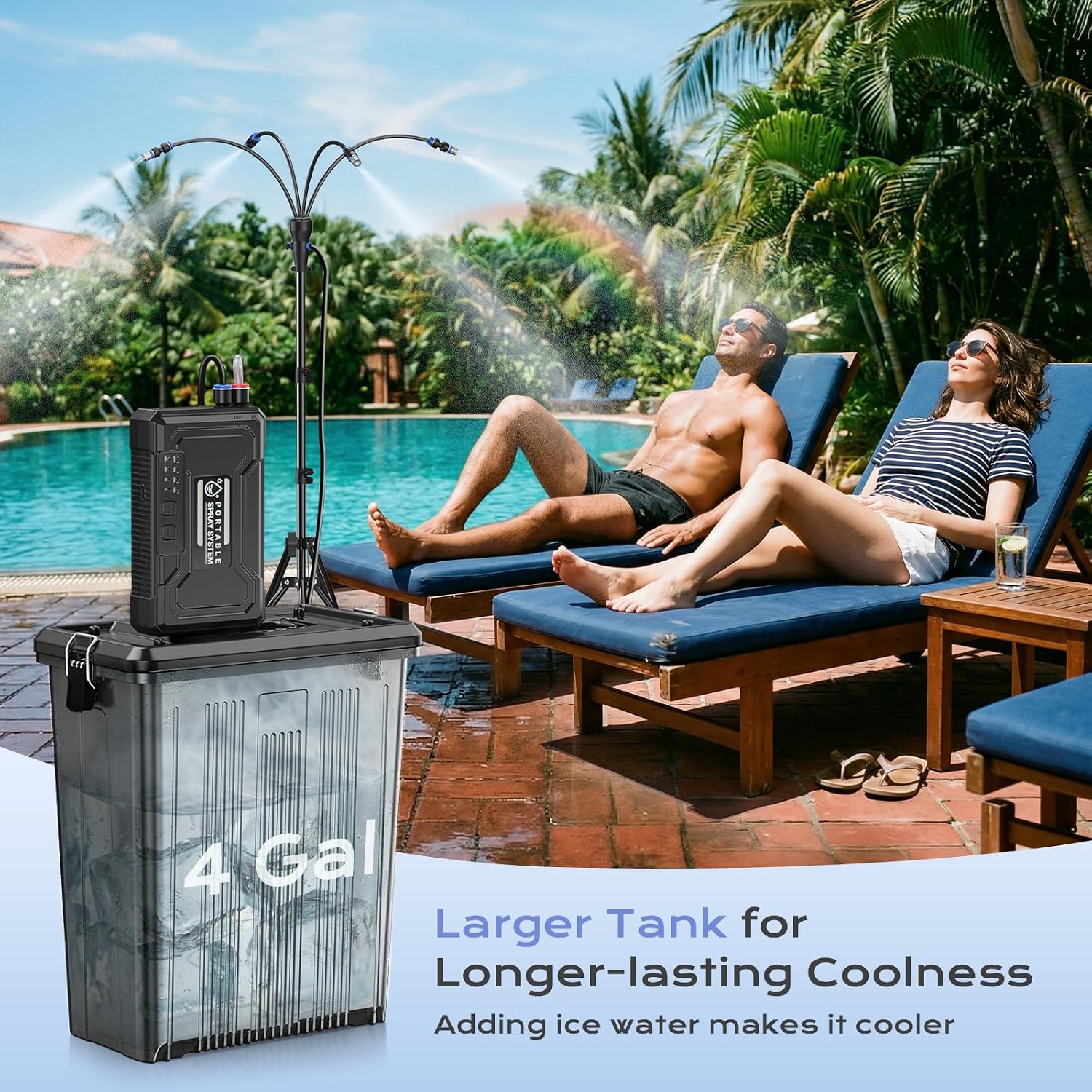
A portable misting system does exactly what it sounds like: it pushes water through tiny nozzles to produce a fine spray — a mist — that evaporates quickly and pulls heat out of the surrounding air. That evaporative cooling effect can drop the perceived temperature at a patio table by 10–25°F on a dry day. The catch is that “portable misting system” covers an enormous range of hardware, from a $40 garden-hose attachment with gravity-fed pressure all the way to a $1,200 battery-tank rig with an onboard booster pump. The difference between those two products isn’t just price — it’s droplet size, throw distance, wetting risk, and whether guests actually feel cool or just feel damp. If you’re sourcing equipment for an outdoor event venue, a hospitality deck, or a seasonal rental fleet, this guide will help you understand the pressure and pump specifications that actually matter, where mid-pressure systems earn their keep, and how to frame the buy-vs-rent math before you commit.
| EDITOR'S PICK[Orbit Arizona Mist 92100 Booste…](https://www.amazon.com/dp/B00280NBEC?tag=greenflower20-20) | Mid-tier[ECO-WORTHY 33-Series Industrial…](https://www.amazon.com/dp/B0BB9M2TS8?tag=greenflower20-20) | Budget pick[Ausic Portable Misting System](https://www.amazon.com/dp/B0H361RL1S?tag=greenflower20-20) | |
|---|---|---|---|
| Power Source | — | 110V AC | Battery |
| Max Pressure | — | 50 PSI | — |
| Flow Rate | — | 4.0 GPM | — |
| Tank Capacity | — | — | 9L |
| Run Time | — | — | 8 hrs |
| Price | $128.99 | $58.13 | $42.49 |
| See on Amazon → | See on Amazon → | See on Amazon → |
Why Pressure Is the Only Spec That Truly Matters
Everything else in a portable misting system — tank size, nozzle count, hose length — is secondary to operating pressure, because pressure determines droplet size, and droplet size determines whether you’re cooling or wetting.
The industry standard measurement for droplet size is VMD, or Volume Median Diameter — the point at which half of the total water volume exists in droplets smaller than that size. At low pressure (under 40 PSI, typical of garden-hose systems), VMD runs roughly 100–200 microns. Droplets that large don’t fully evaporate before they land on skin, fabric, or outdoor furniture. Guests feel wet. At mid-pressure (160–250 PSI), VMD drops to 30–60 microns — small enough to flash-evaporate in dry air before reaching a person two feet from the nozzle line. At high pressure (800–1,000 PSI), VMD can fall below 10 microns, which produces a true fog rather than a mist and is optimal for greenhouse humidity control or industrial dust suppression, but adds significant cost and infrastructure complexity.
For event and patio applications, the mid-pressure window (roughly 160–300 PSI) is the practical sweet spot. The University of California Cooperative Extension, in its guidance on evaporative cooling for outdoor spaces, notes that effective flash evaporation in ambient conditions above 20% relative humidity requires droplets in the 30–70 micron range — achievable at mid-pressure without the plumbing complexity of high-pressure stainless systems.
The three portable pump categories, mapped to pressure:
| Category | Typical PSI | VMD Range | Best Use Case |
|---|---|---|---|
| Battery-tank (no pump) | 20–45 PSI | 120–200 µm | Personal cooling, very small areas |
| Battery-tank + booster pump | 80–160 PSI | 60–100 µm | Small patios, pop-up events under 400 sq ft |
| Dedicated mid-pressure portable rig | 160–300 PSI | 30–60 µm | Full event decks, permanent seasonal installs |
Battery Tanks and Booster Pumps: What You’re Actually Buying
Battery-Powered Backpack and Tank Sprayers
The entry point for portable misting is a pressurized tank — typically 1–4 gallons — that uses either a hand-pump or a battery-driven air compressor to maintain pressure. Brands like Hudson and Solo manufacture agricultural versions of these that operators have adapted for misting duty. Manufacturer specs on Hudson’s battery-powered backpack units put operating pressure at 40–60 PSI, which is enough for basic spray coverage but not for flash evaporation.
Where these units genuinely work: tight situations where you need a no-infrastructure solution — a single vendor booth, a small outdoor ceremony row, a 10×10 tent. Operators in long-run reviews note that run time on a charged battery typically gives 45–90 minutes of continuous spray, which matches the duration of a cocktail hour or a ceremony set.
The material tradeoff matters here. Budget tank units use polyethylene tanks and standard rubber seals. If you’re running anything other than clean municipal water — water with chlorine concentrates, odor-masking fragrance additives, or pest-control actives — you need to verify chemical compatibility before the contract. Chloramine-treated water and many fragrance carriers will degrade standard EPDM seals within a season. Fogco Systems’ buyer documentation specifically notes that operators adding any chemical to misting water should confirm nozzle material (brass vs. stainless) and seal compound (EPDM vs. Viton) before deployment. That’s not a premium-brand upsell — it’s a seal-failure prevention step that applies across all price tiers.
Mid-Pressure Portable Rigs with Dedicated Pumps
Step up to a purpose-built portable misting unit — the category Mistcooling, Fogco, and CoolMist all offer in the $400–$1,200 range — and you’re getting a self-contained system with a diaphragm or piston pump, a pressure regulator, and a reservoir (typically 5–10 gallons) that maintains line pressure at 160–300 PSI without user intervention.
The pump type matters for longevity and serviceability. Diaphragm pumps (common in mid-tier portables) are tolerant of slightly mineral-laden water, easier to rebuild, and widely available with replacement kits. Piston pumps deliver more consistent pressure but are more sensitive to water quality — hard water scaling can damage seals within a single season if the system isn’t flushed. CoolMist’s pump selection guide recommends diaphragm configurations for portable event use precisely because field draining and cleaning between events is often inconsistent.
By the Numbers:
- Mid-pressure portable unit (160–250 PSI): $500–$1,200 purchase price; estimated 3–5 year service life with maintenance
- Rental rate equivalent (event rental market, 2025–2026): $150–$300/day for comparable units
- Break-even on owned vs. rented: approximately 4–8 event days per season
That math shifts significantly if you’re running 15+ event days annually — the owned unit pays back in year one. At 4 or fewer event days a year, rental typically wins on total cost of ownership, especially when you factor in off-season storage, annual seal inspection, and winterization.
The Mid-Pressure Sweet Spot: Where Spending More Changes the Outcome
This is the honest question every procurement decision comes down to: does moving from a $150 battery-tank unit to a $700 mid-pressure rig actually change guest experience?
For patio areas under 200 square feet with a single run of 10–15 nozzles, the gap narrows. A booster-pump-equipped tank unit at 80–120 PSI will produce acceptably small droplets under low-humidity conditions (below 40% RH), and operators report reasonable guest comfort in dry climates. The ASHRAE Handbook’s chapter on evaporative cooling notes that effective cooling drops sharply as ambient relative humidity climbs above 50% — at that point, even mid-pressure droplets struggle to fully evaporate, and the physics stop working regardless of your pump.
But for deck areas above 400 square feet, multi-zone coverage, or events where guest appearance matters (weddings, hospitality venues, branded activations), the pressure differential becomes a real-world differentiator. At 160–250 PSI, you can run longer nozzle lines without pressure drop at the far end, space nozzles at 18–24 inch intervals rather than 12 inches, and maintain consistent droplet sizing across the full run. Fogco’s misting system documentation shows that maintaining line pressure above 150 PSI through a 50-foot run with standard 0.008-inch nozzle orifices requires a pump capable of at least 0.5 GPM (gallons per minute) at rated pressure — a spec that rules out most battery-tank booster pumps.
The other outcome where spending more changes things: chemical compatibility for mosquito or odor-control applications. If your event venue is running a permethrin-based mosquito control protocol through the same misting lines, you need brass or stainless nozzles, Viton seals, and a pump rated for chemical service. Per npic.orst.edu’s guidance on permethrin applications, incorrect material compatibility can result in active ingredient degradation and accelerated equipment failure — both of which undermine the application and your equipment warranty simultaneously.
Nozzle Selection and Layout: Where Mid-Pressure Gets Wasted
Operators new to mid-pressure systems sometimes invest in the pump and then install low-quality nozzles, inadvertently wasting the pressure advantage. A 250 PSI pump feeding plastic orifice nozzles with loose tolerances will produce inconsistent droplet sizing and flow variance across the line. The nozzle is where the pressure converts to VMD — it’s the final performance variable.
Brass nozzles with orifice sizes in the 0.006–0.010 inch range are the standard for mid-pressure patio misting. Stainless is the upgrade for chemical service or high-UV environments (UV degradation of plastic nozzle bodies is well-documented in long-term outdoor installations). Mistcooling’s technical specifications for their portable series call out stainless-orifice nozzles as standard precisely because UV-exposed plastic orifices can drift in diameter within a single outdoor season, producing larger droplets than rated.
Layout rules of thumb that hold across mid-pressure portables:
- Nozzle spacing: 18–24 inches for patio perimeter runs at 160–250 PSI
- Maximum run length before a pressure-drop penalty: 50 feet for 3/8-inch poly line; 75–100 feet for 1/2-inch line
- Nozzle count per pump capacity: divide pump GPM by per-nozzle flow (typically 0.03–0.05 GPM per nozzle at rated pressure) to confirm your pump isn’t undersized for the line
Decision Framework: If X, Then Y
Before you finalize a portable misting purchase, run through these five decision gates:
If your event footprint is under 200 sq ft and humidity stays below 40% RH: A quality booster-pump battery tank unit ($150–$350) will perform adequately. Save the capital for other venue infrastructure.
If you’re running 400+ sq ft, multiple zones, or upscale hospitality events: A mid-pressure portable rig at 160–250 PSI is the minimum entry point. Budget $600–$1,200 and spec diaphragm pump + brass nozzles.
If you’re adding any chemical to the misting water (mosquito control, fragrance, sanitizer): Mandatory: verify Viton seals and brass/stainless nozzles before purchase. The pump model and nozzle material matter more than the brand name.
If your annual event count is fewer than 6 days: Run the rental math first. At 2025–2026 rental rates, owned mid-pressure units don’t break even until year two at that frequency.
If you’re in a humid climate (above 55% average RH during your operating season): Mid-pressure misting provides only moderate cooling benefit once humidity climbs. Evaluate whether shade structures or supplemental airflow deliver better ROI than a misting upgrade — the evaporative physics have a ceiling regardless of pump quality.
The mid-pressure portable category has matured enough that well-specified units from Mistcooling, Fogco, and CoolMist are genuinely reliable for commercial deployment — but the performance ceiling is set by pressure, nozzle quality, and application humidity, not by brand. Match the spec to the use case, confirm chemical compatibility before the contract, and the math on ownership gets straightforward.