May 24, 2026 • Elena Garcia • 9 min reading time • Specs verified June 25, 2026
Greenhouse Humidity Control: ULV Foggers, Ultrasonic Misters, and VPD-Aware Humidifiers for Serious Cultivators
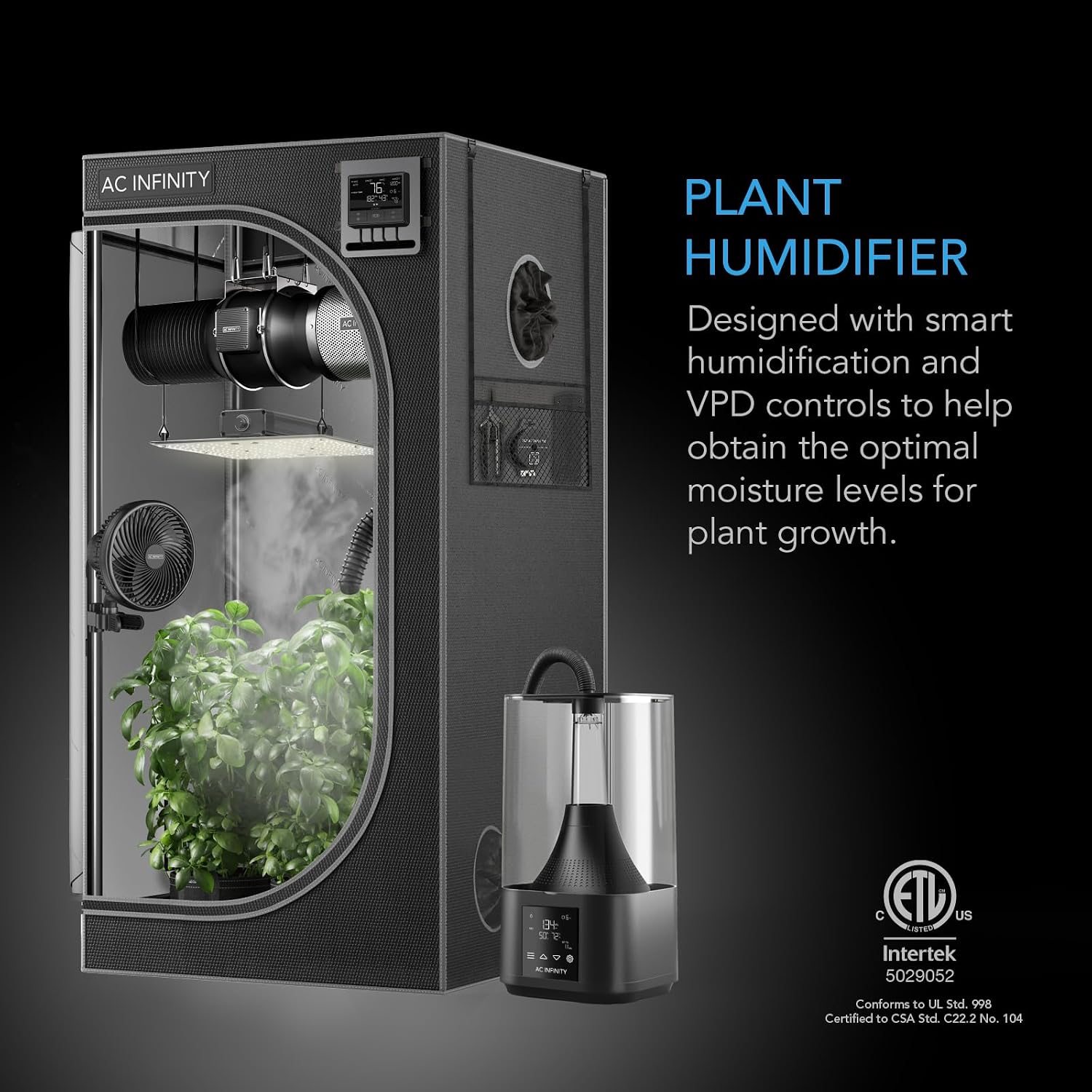
Getting humidity right inside a greenhouse sounds simple — just add water vapor to the air — but the details matter more than most growers expect until they’ve watched a tomato crop crack or a cannabis canopy develop powdery mildew. Humidity, measured as relative humidity (RH, the percentage of moisture in the air relative to how much it can hold at that temperature), directly controls how fast plants transpire and absorb nutrients. The more sophisticated target growers now chase is called VPD — Vapor Pressure Deficit — which is essentially the “thirst” of the air: how hungry the atmosphere is to pull moisture out of your plants’ leaves. A low VPD (humid air) slows transpiration; a high VPD (dry air) stresses plants into closing their stomata and starving themselves of CO₂. The sweet spot is crop-specific, growth-stage-specific, and time-of-day-specific. This guide will help you choose between the three main hardware categories — ULV cold foggers, ultrasonic misters, and dedicated VPD-aware humidification systems — with enough specificity to inform a real purchase decision.
The Three Technologies and What They’re Actually Doing to Your Air
Before comparing units, it helps to understand what each technology physically produces, because the droplet or particle size determines almost everything else: how quickly it evaporates, whether it wets surfaces, and how far it travels through a canopy.
ULV (Ultra-Low Volume) cold foggers use a high-velocity air stream — generated by a centrifugal blower — to shear a liquid into a fine aerosol mist. Droplet size typically falls in the 5–50 micron VMD (Volume Median Diameter) range, depending on the unit, liquid viscosity, and flow rate settings. Brands like Vectorfog and Pulsfog publish VMD data on their spec sheets; at the lower end of that range, the aerosol behaves almost like a gas, hanging in the air column for 5–15 minutes before settling. This is why ULV foggers were developed for pest control and fungicide application — the aerosol penetrates dense canopy structure that a sprayer can’t reach.
Ultrasonic misters use a piezoelectric transducer vibrating at high frequency (typically 1.7–2.4 MHz) to atomize water directly at the water surface, producing droplets in the 1–5 micron range — genuine “fog” that looks like stage smoke and stays aloft almost indefinitely. The appeal for humidity control is obvious: near-instant evaporation, minimal leaf wetness, and precise control. The practical limitation is also real: ultrasonic units require clean, treated (typically RO or DI) water to avoid mineral dust depositing white residue on leaves and growing media.
VPD-aware humidification systems is a broader category that includes both high-pressure fogging lines (think 1,000 PSI+ systems from Fogco or Mistcooling) and ducted evaporative or steam humidifiers wired into a climate controller with real-time VPD sensing. The distinguishing feature isn’t the humidification mechanism — it’s the control loop. These systems read temperature and RH simultaneously, calculate VPD, and modulate output to hit a set point rather than simply blasting humidity on a schedule.
VPD Math: Why the Target Number Changes Everything
If you’re not already working to VPD targets, this section is worth slowing down on. Hort Week’s coverage of protected cropping environments notes that most commercial vegetable and high-value floriculture operations have migrated away from flat RH targets entirely, because RH alone is meaningless without knowing air temperature.
The simplified VPD formula: VPD (kPa) = SVP × (1 − RH/100), where SVP is the Saturation Vapor Pressure at the current air temperature. At 77°F (25°C), SVP is about 3.17 kPa. Run that at 70% RH and you get a VPD of ~0.95 kPa — fine for late-veg cannabis. Drop the temperature to 68°F but keep RH at 70%, and VPD falls to ~0.84 kPa — now you’re in early-veg territory.
By the Numbers: VPD Target Ranges by Growth Stage
| Growth Stage | VPD Target (kPa) | Equivalent RH @ 77°F |
|---|---|---|
| Propagation / Clones | 0.4 – 0.8 | 75 – 87% |
| Vegetative | 0.8 – 1.2 | 62 – 75% |
| Early flower | 1.0 – 1.5 | 53 – 69% |
| Late flower / finishing | 1.2 – 1.6 | 50 – 62% |
Sources: UC Davis Cooperative Extension greenhouse management guidance; Greenhouse Grower crop quality reporting.
What this table means for equipment selection: if your controller can’t read both temperature and RH simultaneously and calculate VPD, you’re flying partly blind. The hardware decision and the controls decision are inseparable.
Matching Equipment to Application: The Decision Matrix
ULV Foggers — Best for Pest/Disease Applications, Useful but Limited for Routine Humidity
ULV foggers — units like the Vectorfog C100+, Pulsfog K-10, or Hudson Fog Electric — are the workhorse of licensed pest control and IPM (Integrated Pest Management) programs. In a greenhouse context, they shine when you need to apply a fungicide, beneficial microorganism suspension, or miticide through a dense canopy without labor-intensive manual spraying.
As humidity-control tools in a standalone role, they’re less elegant. PCT Online’s equipment maintenance coverage notes that ULV foggers aren’t designed for continuous operation — duty cycles vary by model, and running a 1,200-watt blower motor in a humid greenhouse for four-hour stretches will shorten brush and bearing life without proper maintenance intervals. More practically, the application is inherently episodic: you fog, the humidity spikes, then it drifts back down. Unless you have a programmatic controller triggering the unit in short bursts, holding a ±5% RH band is difficult.
Where ULV earns its place in a well-equipped greenhouse: as the treatment tool rather than the climate tool. If you’re a licensed operator running multiple houses or doing contract applications, a unit in the Vectorfog C100 or Pulsfog K-10 class gives you canopy penetration no backpack sprayer matches. The EPA’s ULV application guidance is clear that registered fungicide and pesticide use through these units requires following label rates for the application method — “fogging” and “spraying” are separate use patterns, and the label controls.
Chemical compatibility note: Polyurethane tank liners and standard neoprene seals (common in mid-tier ULV units) degrade with repeated exposure to petroleum-based solvents and some emulsifiable concentrate formulations. Operators running EC-formulation fungicides or oil-based adjuvants should verify tank material compatibility before committing to a unit — Pulsfog publishes a chemical resistance table in their operator documentation; Vectorfog customer support can confirm specific formulations.
Ultrasonic Misters — Precision Humidity, Water Quality Non-Negotiable
For propagation chambers, cloning rooms, and high-value cultivation spaces where leaf wetness disease risk is real, ultrasonic systems offer the best precision-to-footprint ratio in their price tier. A multi-head ultrasonic unit with 10–15 transducer heads can maintain ±3% RH in a 10×20 ft space when paired with even a basic RH controller.
The investment calculus changes depending on your water quality situation. Ultrasonic systems require RO (reverse osmosis) or DI (deionized) water to avoid white mineral dust — the same calcium and magnesium that would scale your irrigation lines will coat your plant canopy and growing media with a white residue that blocks stomata and raises media pH over time. If you already run RO water for irrigation, the incremental cost of routing it to your ultrasonic system is low. If you don’t, factor in an RO unit ($200–$600 for a basic greenhouse-rated unit) before comparing sticker prices.
Transducer life is the other TCO (total cost of ownership) variable most buyers miss. Across aggregated commercial grower forums and published reviews in Greenhouse Grower, transducer life in continuous-duty applications typically runs 3,000–8,000 hours, heavily influenced by water quality. At $8–$25 per transducer head for replacement parts on common units, a 12-head system running 16 hours daily may need transducer replacements every 12–18 months. That’s a real operating cost, not a one-time purchase.
High-Pressure Misting Systems and VPD-Aware Controllers — The Commercial Standard
For operations above roughly 2,000 sq ft of growing space, or anywhere you’re managing multiple zones with different crop stages simultaneously, the combination of a high-pressure misting line and a VPD-capable environmental controller is the commercial standard for good reason.
High-pressure systems (operating at 800–1,200 PSI) atomize water through stainless or ceramic nozzles at droplet sizes in the 10–20 micron range — fine enough for rapid evaporation, large enough to be less sensitive to mineral content than ultrasonics. Manufacturers like Fogco, Mistcooling, and CoolMist offer engineered systems with stainless line, pressure-rated fittings, and nozzle spacing calculated for your square footage and airflow pattern. A turnkey system for a 5,000 sq ft greenhouse runs $3,000–$8,000 installed, depending on zone count and control integration.
The control layer is where the real ROI materializes. Environmental controllers from brands like Argus, Priva, and Ridder — systems used at the commercial scale — integrate temperature, RH, CO₂, and light data to calculate real-time VPD and modulate humidification output against a crop-stage set point. Even at smaller scales, controllers from Inkbird, Titan Controls, or similar mid-tier brands can run two-stage humidity control (low-RH triggers misting; high-RH triggers ventilation) for under $300, paired with a relay-controlled misting pump.
The UC Davis Cooperative Extension’s greenhouse management guidance explicitly identifies dynamic humidity control tied to temperature as a primary factor in reducing Botrytis (gray mold) incidence — one of the most economically damaging diseases in high-value greenhouse production. The mechanism is direct: Botrytis spore germination requires free water on leaf surfaces and sustained RH above 90%. A system that maintains VPD set points rather than flat RH targets can hold the environment below disease-conducive conditions without sacrificing transpiration-driven growth.
The Decision Rule
If you’re a licensed pest-control operator or IPM contractor working multiple greenhouse accounts: a quality ULV fogger is a core tool for fungicide and pesticide applications, and the VPD/humidity conversation is separate. Source your fogging equipment for canopy penetration and chemical compatibility; source your humidity system on its own merits.
If you’re a cultivator managing under 2,000 sq ft with good water quality: an ultrasonic system with basic RH control is the most cost-efficient path to precision humidity at the propagation and vegetative stages. Budget for RO water upfront and transducer replacement annually.
If you’re managing 2,000 sq ft or more, running multiple crop stages, or justifying this as a capital equipment decision against crop loss or quality metrics: high-pressure misting tied to a VPD-aware controller is the defensible commercial choice. The sticker price is higher; the cost per avoided disease event and per percentage point of yield improvement makes the math work at commercial scale. Run your own numbers against last season’s Botrytis losses or humidity-related quality downgrades — in most operations above 3,000 sq ft, the system pays back in under two years.
The worst outcome isn’t buying the wrong brand — it’s buying the right technology and wiring it to a controller that can’t calculate VPD. The hardware is a commodity; the control logic is the crop decision.