September 13, 2026 • Elena Garcia • 11 min reading time • Specs verified June 25, 2026
Garden-Hose Misting Kits at 59 to 100 Feet: What Brass Nozzles and UV Tubing Really Deliver
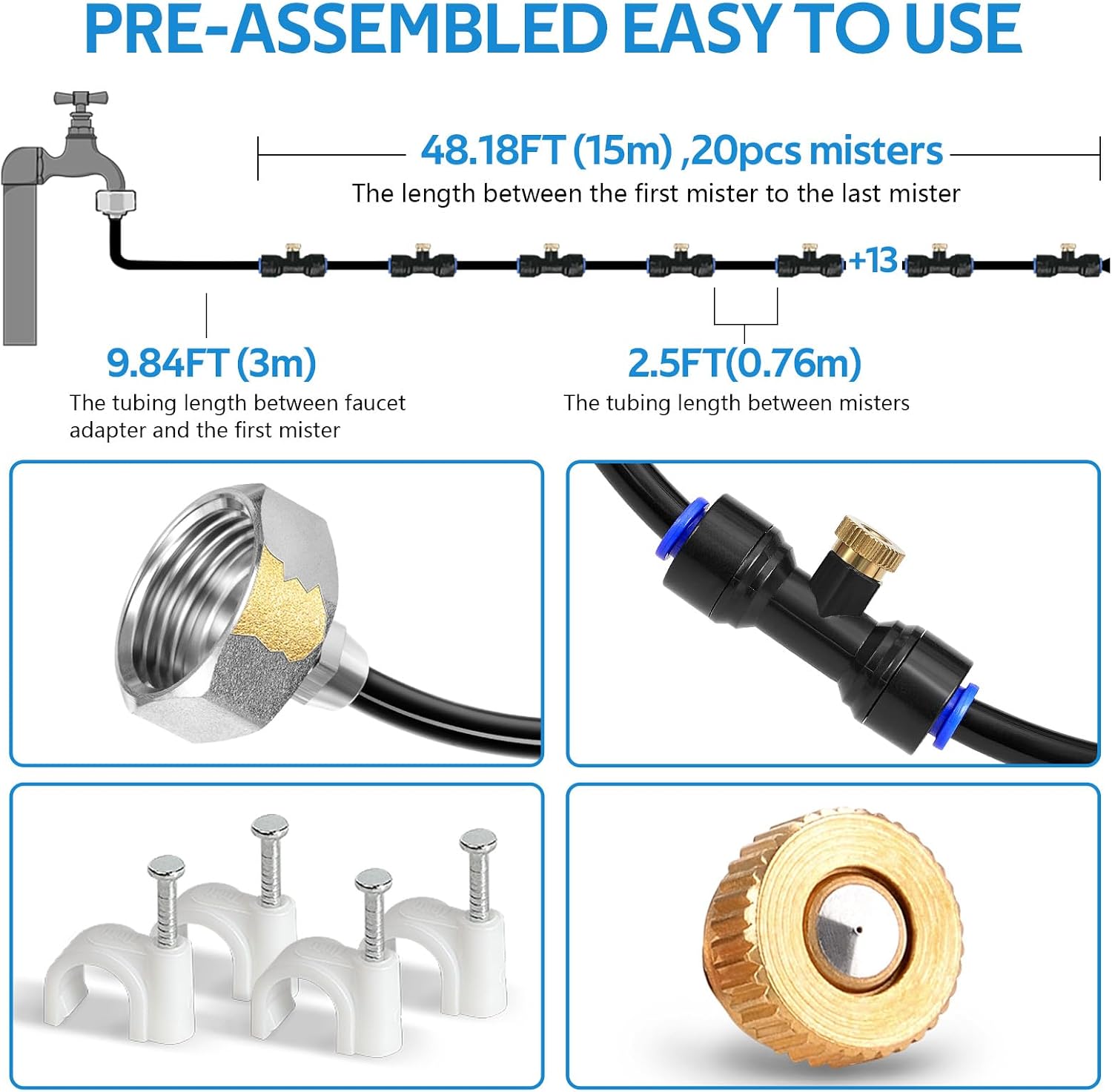
A garden-hose misting kit is exactly what it sounds like: a length of small-diameter flexible tubing — typically ¼ inch — pre-fitted with a series of spray nozzles that you connect directly to a standard outdoor spigot. Turn on the water, and each nozzle atomizes the flow into a fine mist. As those tiny water droplets evaporate in dry air, they pull heat with them, dropping the perceived temperature around the zone. No pump, no compressor, no electrician required. These kits have become a genuine weekend-project staple for patios, pergolas, chicken runs, greenhouses, and plant rows, and the 59-to-100-foot length range — the most common retail configuration — covers a surprising amount of ground. This guide is for buyers who are past the “does it work?” question and into the “how do I spec and size this correctly?” territory. We’ll cover nozzle material tradeoffs, realistic pressure and flow numbers, the upgrade path to a booster pump, and the quality patterns that emerge from aggregated owner experience across the leading kits.
| EDITOR'S PICKMaotong 100FT Mister for Outsid… | Mid-tierhomenote Misting Cooling System… | Budget pickHOMENOTE 10 Pack Brass Misting… | |
|---|---|---|---|
| Hose length | 100 ft | 75 ft | — |
| Brass nozzles | 32 | 28 | 10 |
| Water filter | ✓ | — | — |
| Brass adapter | — | 3/4" | — |
| Pre-assembled | — | ✓ | — |
| Tubing size | — | — | 1/4" |
| Price | $33.98 | $26.35 | $9.99 |
| See on Amazon → | See on Amazon → | See on Amazon → |
What Brass Nozzles Actually Change — and What They Don’t
The nozzle is the most consequential single component in a garden-hose misting kit, and the brass-versus-plastic divide is real — but it’s not unlimited.
The case for brass. Brass nozzles are harder, more dimensionally stable, and far more serviceable than their injection-molded plastic counterparts. The orifice — the tiny hole that determines droplet size — holds its geometry under heat cycling and mineral deposit pressure in a way that plastic simply doesn’t. Homenote brass nozzle reviewers in Arizona, a market with hard water and extreme UV exposure, consistently report the ability to fully disassemble each nozzle, soak it in a descaling solution, and return it to spec. One chicken-yard owner’s account of daily use over an extended season with zero clogging failures is notable precisely because that application involves constant-run cycles in dusty, high-mineral-water conditions — exactly the scenario that chews through plastic nozzles in a matter of weeks.
What brass doesn’t fix. A brass nozzle on a kit running at 30–40 PSI (pounds per square inch — the pressure your municipal water supply delivers at the spigot) is still a low-pressure nozzle. High-pressure misting systems run at 800–1,000 PSI and produce droplets in the 5–20 micron VMD (volume median diameter — the droplet size at which half the water mass is in smaller drops, half in larger) range, which evaporate almost before they land. Garden-hose kits at standard residential pressure produce droplets in the 50–100 micron range. Those drops evaporate, but more slowly — and if you overload the line with too many nozzles, they don’t evaporate at all; they just wet surfaces. Brass nozzles at low pressure are more durable and more maintainable than plastic nozzles at low pressure. They are not a substitute for pressure.
The bulk-buyer quality caveat. One procurement pattern worth flagging for anyone specifying a large pergola or commercial patio: a reviewer who purchased 200–300 brass nozzles across multiple 10-packs reported a consistent defect rate of approximately 2–3 units per 10-pack. That’s a 20–30% failure yield — not a reason to avoid brass kits, but a reason to order 15–20% more nozzles than your layout requires and inspect each one before installation. For a 10-nozzle residential line, this is a minor annoyance. For a 60-nozzle venue installation, it’s a line item in your planning.
Pressure, Flow, and Nozzle Count: The Math That Determines Mist Quality
This is where most kit buyers get into trouble, because the relationship between nozzle count and mist quality is non-linear once you pass a threshold.
Standard residential water pressure in the U.S. typically runs 40–60 PSI at the meter, with delivered pressure at an outdoor spigot often in the 30–50 PSI range depending on pipe run and elevation. Garden-hose misting kits are designed to operate in this window.
Each nozzle consumes flow. A standard ⅟₁₆-inch orifice nozzle at 40 PSI moves approximately 0.8–1.2 gallons per hour. Run 10 nozzles and you’re drawing 8–12 GPH (gallons per hour) — well within what a ¾-inch residential supply line can deliver without pressure drop. Run 20 nozzles and you’re at 16–24 GPH; at 30 nozzles, 24–36 GPH. The pressure drop across ¼-inch tubing compounds the problem: thin tubing has measurable friction losses over distance, so the nozzles at the far end of a 100-foot run see materially less pressure than those near the inlet.
By the Numbers
| Nozzle Count | Approx. Flow Draw (40 PSI) | Expected Far-End Pressure (100 ft ¼” tubing) | Mist Quality |
|---|---|---|---|
| 10 | ~10 GPH | ~35–38 PSI | Good atomization |
| 20 | ~20 GPH | ~28–33 PSI | Acceptable; some drip at far end |
| 30+ | ~30+ GPH | <25 PSI likely | Wet mist; surface wetting probable |
Per the University of California Cooperative Extension’s publication on evaporative cooling for livestock and poultry (UC ANR Publication 8359), effective evaporative cooling requires droplets to evaporate before reaching the target surface — a function of both droplet size and the vapor-pressure deficit (how dry the surrounding air is). In arid climates like Arizona or the inland Southwest, even 50–80 micron droplets from a garden-hose kit evaporate efficiently; in humid Southeast conditions above 60–70% relative humidity, no garden-hose kit will deliver true evaporative cooling regardless of nozzle quality. Greenhouse Grower’s editorial coverage of controlled-environment humidity management makes the same point: evaporative efficiency is an air-condition problem first, an equipment problem second.
The practical rule: cap your single-inlet garden-hose kit at 15–18 nozzles for reliable mist quality at standard residential pressure. Beyond that, split the line into two inlet feeds or move to a booster pump.
UV Tubing, Timer Integration, and the Pump Upgrade Path
UV-stabilized tubing matters more than most buyers realize. The ¼-inch polyethylene tubing in quality kits like those from Homenote, Bonviee, and Maotong is specified as UV-resistant — meaning it contains carbon black or UV-stabilizer additives that slow photodegradation. This Old House’s installation guide for patio misting systems specifically flags UV degradation of plastic tubing as the primary failure mode in permanent outdoor installations, noting that un-stabilized tubing can become brittle and crack within a single season in high-UV regions. Manufacturer pressure ratings for the ¼-inch tubing in these kits typically run 87–100 PSI burst pressure, with a working pressure rating of approximately 40–60 PSI — which aligns with standard municipal supply but leaves essentially zero margin if you add a booster pump without first verifying the tubing spec. A Maotong owner’s question about pressure ratings before adding a pump is well-founded: the answer is to confirm the tubing’s rated working pressure with the manufacturer before pressurizing above 60 PSI, or replace the tubing with rated high-pressure line (1/4-inch nylon rated to 150+ PSI working pressure) before running a pump.
Timer integration is genuinely straightforward. Multiple owners across all three brands describe running their misting kits through standard hose-thread irrigation timers — the same battery-operated units used for drip irrigation — and using them as automated plant watering systems during off-peak hours. This dual-use case (cooling + irrigation) is well-supported by the kit designs: the tubing fittings are standard push-in compression style, and the hose connection accepts any ¾-inch GHT (garden hose thread) timer or valve. The EPA’s guidance on outdoor habitat modification notes that timed, targeted watering reduces standing-water accumulation compared to manual hose watering — relevant for mosquito management if you’re running a misting kit in a densely planted garden.
When a booster pump changes the outcome. The upgrade decision comes down to one variable: ambient humidity. In climates with summer relative humidity consistently below 40–50% (Arizona, New Mexico, inland California, Nevada), a well-configured garden-hose kit at standard pressure genuinely delivers — one reviewer specifically measured a 12-degree Fahrenheit temperature drop on a patio, with the zone reading 2 degrees cooler than the interior of the adjacent home after mounting on a wisteria trellis rather than the roof (lower mounting = shorter evaporation path = more efficient cooling). In those conditions, a booster pump is an upgrade for larger coverage, not a necessity for performance.
In humid climates — the Gulf Coast, Florida, the mid-Atlantic in summer — a booster pump pushing 150–200 PSI with finer-orifice nozzles (0.012–0.015 inch) produces genuinely smaller droplets that have a better chance of evaporating before landing, but even then, relative humidity above 70% caps the physics. The honest answer: if you’re in a humid climate and want true cooling rather than moisture, you need a high-pressure system (800–1,000 PSI), not a booster pump on a garden-hose kit. The pump upgrade is worth the cost when it’s solving a pressure-drop problem on a large installation — not when it’s trying to overcome ambient humidity.
Buying Decision Framework: If X, Then Y
If you’re in an arid or semi-arid climate (RH below 50% in summer), running 15 or fewer nozzles, and want a seasonal or semi-permanent patio setup: A Homenote, Bonviee, or Maotong kit with brass nozzles in the 59–100-foot range will deliver real temperature reduction. Prioritize brass nozzles over plastic for serviceability, confirm UV-rated tubing, and add a timer for automated operation. This is the right tier for the money.
If your installation exceeds 20 nozzles or 80 feet of single-inlet run: Split the feed into two inlets from separate spigots, or plan for a booster pump from the outset. Order 15–20% more nozzles than your layout requires to account for the 2–3-per-10-pack defect rate documented in bulk orders.
If you want to add a booster pump to an existing garden-hose kit: Verify the tubing’s rated working pressure before exceeding 60 PSI. If the manufacturer doesn’t publish a working pressure spec, replace the tubing with ¼-inch nylon rated to 150 PSI working pressure before pumping. The kit’s push-in fittings may also need replacement with compression fittings rated for the higher pressure.
If you’re in a humid climate (RH above 60% in summer): Manage expectations. The misting effect will be present and pleasant for perceived cooling, but thermometer measurements will show more modest drops than arid-region reviews suggest. For genuine cooling in humid conditions, a high-pressure misting system is a different category of investment and a different article.
Frequently Asked Questions
Will a garden-hose misting kit actually make my patio feel cooler or just wet everything down? In dry climates (RH below 50%), yes — owner reports consistently describe real, measurable temperature drops, with one reviewer documenting 12°F of measured cooling. The key is correct nozzle count for your pressure. Too many nozzles on one feed drops pressure below the atomization threshold and produces wetting rather than mist.
How many nozzles can I run on standard home water pressure before mist quality degrades? Based on published flow rates and friction-loss data for ¼-inch tubing, 15–18 nozzles is the practical ceiling for a single-inlet kit at 35–50 PSI. Beyond that, split the line into two feeds.
Do brass nozzles clog less than plastic nozzles and how do I clean them? Brass nozzles are more resistant to mineral scale damage and fully disassemblable — you can soak the orifice insert in white vinegar or a commercial descaler and return it to spec. Plastic nozzles cannot be reliably disassembled without damage. Arizona owners with hard water specifically cite this serviceability as the reason brass nozzles outlast plastic by a wide margin in high-mineral-water conditions.
Can I connect these kits to an automatic timer? Yes. The ¾-inch GHT inlet connection on all three brands accepts standard battery-operated irrigation timers directly. Multiple owners use this configuration for automated plant watering on a schedule.
What is the maximum pressure rating of the ¼-inch tubing in these kits? Manufacturer specs for the UV-stabilized polyethylene tubing in these kits typically indicate a burst pressure of 87–100 PSI and a working pressure of 40–60 PSI. Do not exceed the stated working pressure without upgrading to higher-rated tubing.
At what point does adding a booster pump become worth the extra cost? When pressure drop on a long or high-nozzle-count run is the documented problem — not when the goal is to overcome humidity. A pump that takes a 100-foot, 25-nozzle run from 25 PSI to 50 PSI will meaningfully improve mist quality. A pump added to a correctly sized 10-nozzle run in a humid climate will not transform the system into a high-pressure misting rig; the physics of evaporation in humid air remain the binding constraint regardless of pressure.