August 18, 2026 • Elena Garcia • 12 min reading time • Specs verified June 25, 2026
ULV Foggers for Disinfecting, Mold, and Odor: Corded vs. Cordless vs. Electrostatic
A ULV fogger — short for Ultra-Low Volume fogger — is a machine that breaks liquid chemical solutions into an extremely fine mist of tiny airborne droplets, typically between 5 and 50 microns in diameter (a human hair is roughly 70 microns wide). That droplet cloud floats through the air and settles onto surfaces, into cracks, and across hard-to-reach geometry far more efficiently than spray bottles or pump sprayers ever could. For disinfection, mold remediation, and odor neutralization, that coverage difference is the entire value proposition. But “ULV fogger” covers a wide spectrum of machines — corded electric units that run continuously off an outlet, battery-powered cordless units that trade runtime for freedom of movement, and electrostatic foggers that add an electrical charge to droplets so they actively wrap around surfaces rather than just falling on top of them. Each design makes a different set of tradeoffs. This article walks you through those tradeoffs with enough specificity to defend a purchasing decision, whether you’re outfitting a single restoration crew or evaluating a fleet addition.
| EDITOR'S PICKHurricane Ultra II Corded ULV H… | Mid-tierXPOWER F-16 ULV Cold Fogger | Budget pickCreatech Commander Tri Jet ULV… | |
|---|---|---|---|
| Tank size | 1 gal | 1.6 L | — |
| Droplet size | 10-50 microns | — | — |
| Spray distance | — | 30+ ft | — |
| Jet type | — | — | Tri Jet |
| Price | $382.99 | $217.81 | |
| See on Amazon → | See on Amazon → | See on Amazon → |
The Core Tradeoff Triangle: Power, Mobility, and Surface Wrap
Before comparing specific machines, the framework matters. For disinfecting and mold applications, you’re optimizing across three variables simultaneously.
Droplet size (VMD — Volume Median Diameter): Smaller droplets (5–20 microns) stay airborne longer and penetrate porous surfaces and hidden cavities. Larger droplets (30–50 microns) deposit faster and carry more active ingredient per particle onto hard surfaces. Mold remediation often benefits from slightly larger VMD to drive penetrant into porous building materials; airborne disinfection favors smaller VMD for dwell time in the air column; surface disinfection is a middle case where electrostatic charging can substitute for fine particle size.
Output rate (ml/min): Higher output covers square footage faster but burns through chemical and can over-wet sensitive surfaces. Most commercial-grade ULV units for indoor disinfection run 0–120 ml/min with adjustable flow. Operators experienced in mold work consistently report that running a unit at its lowest particle size setting with moderate flow yields the best penetration into wall cavities without saturating drywall.
Chemical compatibility: This is where operators get burned. Hypochlorous Acid (HOCl), a popular electrochemically generated disinfectant increasingly used by medical and commercial cleaning professionals, is mildly corrosive — particularly to brass fittings and certain elastomers. Bleach-based formulations and quaternary ammonium compounds each have their own compatibility profiles. According to the NPIC Disinfectants and Sanitizers General Fact Sheet (National Pesticide Information Center, Oregon State University), always verify the active ingredient’s corrosivity rating against the fogger’s wetted-parts list before first use.
Corded, Cordless, and Electrostatic: Head-to-Head Comparison
The three machine categories serve meaningfully different use cases. The sections below break each down with specific units, documented operator experience, and a tier marker so you can match budget to application.
Corded ULV Foggers: Maximum Runtime, Zero Battery Anxiety
For operators running multi-room or multi-floor jobs — post-flood mold remediation in a commercial building, or a pest-control operator treating a warehouse — a corded ULV unit is the natural center of gravity. Unlimited runtime, consistent motor speed regardless of battery state, and typically the highest output rates available in the category make corded units the workhorse choice for volume applications.
The XPOWER F-16 is the machine that shows up repeatedly in professional contexts. Pest control operators specifically credit the fine particle output and adjustable flow for meaningful product savings on routes. The F-16 runs on 120V AC and is rated for continuous operation in the kind of volume that would exhaust a cordless unit in half a shift. For disinfection applications, the particle size dial matters more than the output dial: operators report running it at finer settings to treat HVAC pathways and wall-cavity dead zones that a coarser fog would miss.
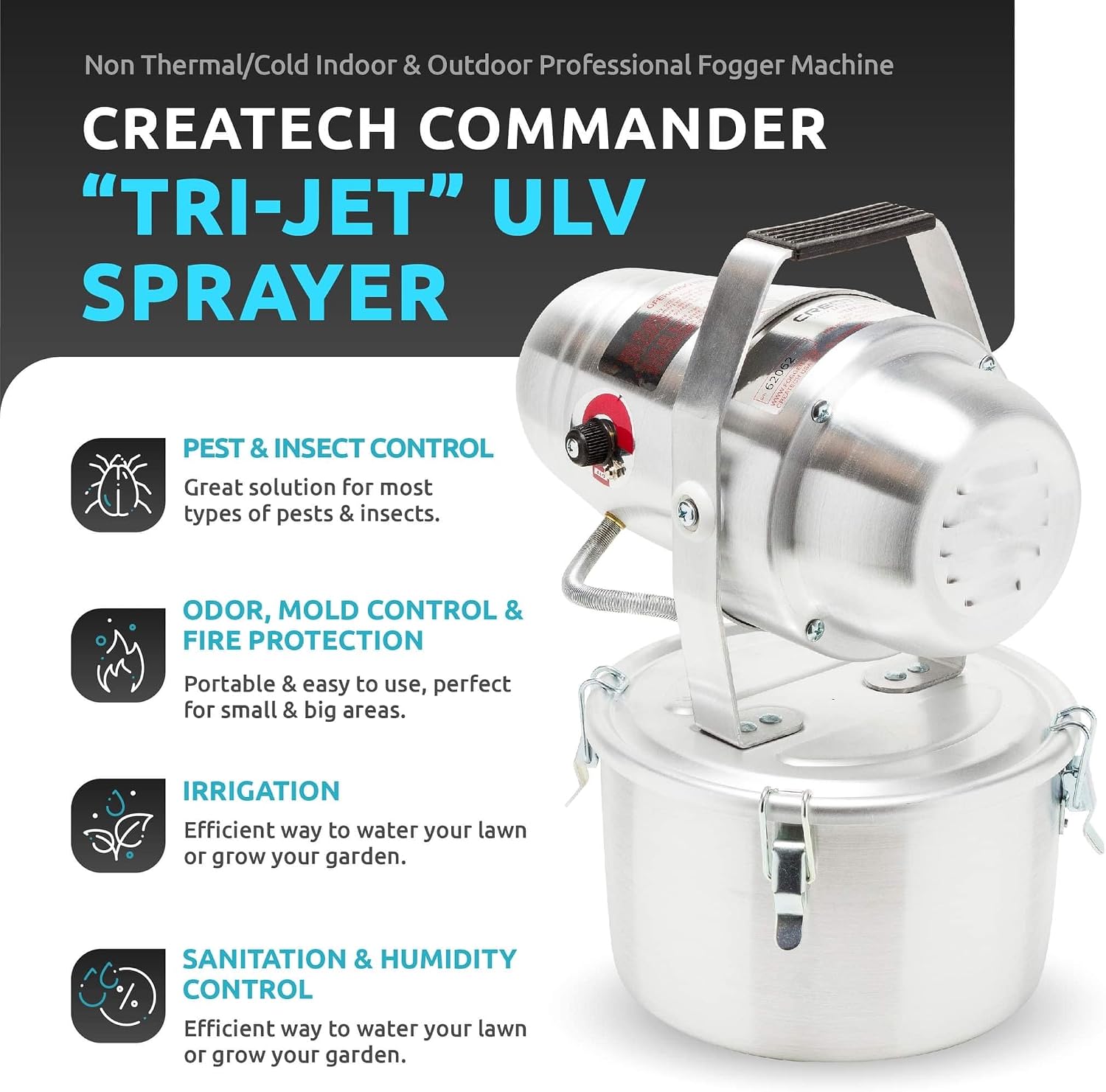
The Createch Commander occupies a different niche than its consumer positioning suggests. Operators using it for mold remediation — specifically with Concrobium, a widely used mold-control product — are the most engaged voices in its documented use record. The consistent complaint is that the included instructions are inadequate for chemical application workflows; multiple owners found Concrobium’s own official application guidance more useful than anything in the box. For a practitioner building a mold remediation workflow, that instruction gap is a real operational cost: you need to source application protocol externally and train around it. The machine handles the chemical adequately for small-to-medium residential spaces, but the documentation failure means your technicians need to arrive knowing the protocol, not learning it from the manual.
The Smith ULV sits at a lower price point and earns genuinely positive reviews from backyard pest control users — documented cases include eliminating severe mosquito infestations in dense overgrown brush — but its core strengths are outdoor pest management, not indoor disinfection or mold. Wetted-parts compatibility with HOCl and oxidizing disinfectants has not been systematically documented by operators in the use record, which matters if disinfection is your primary application.
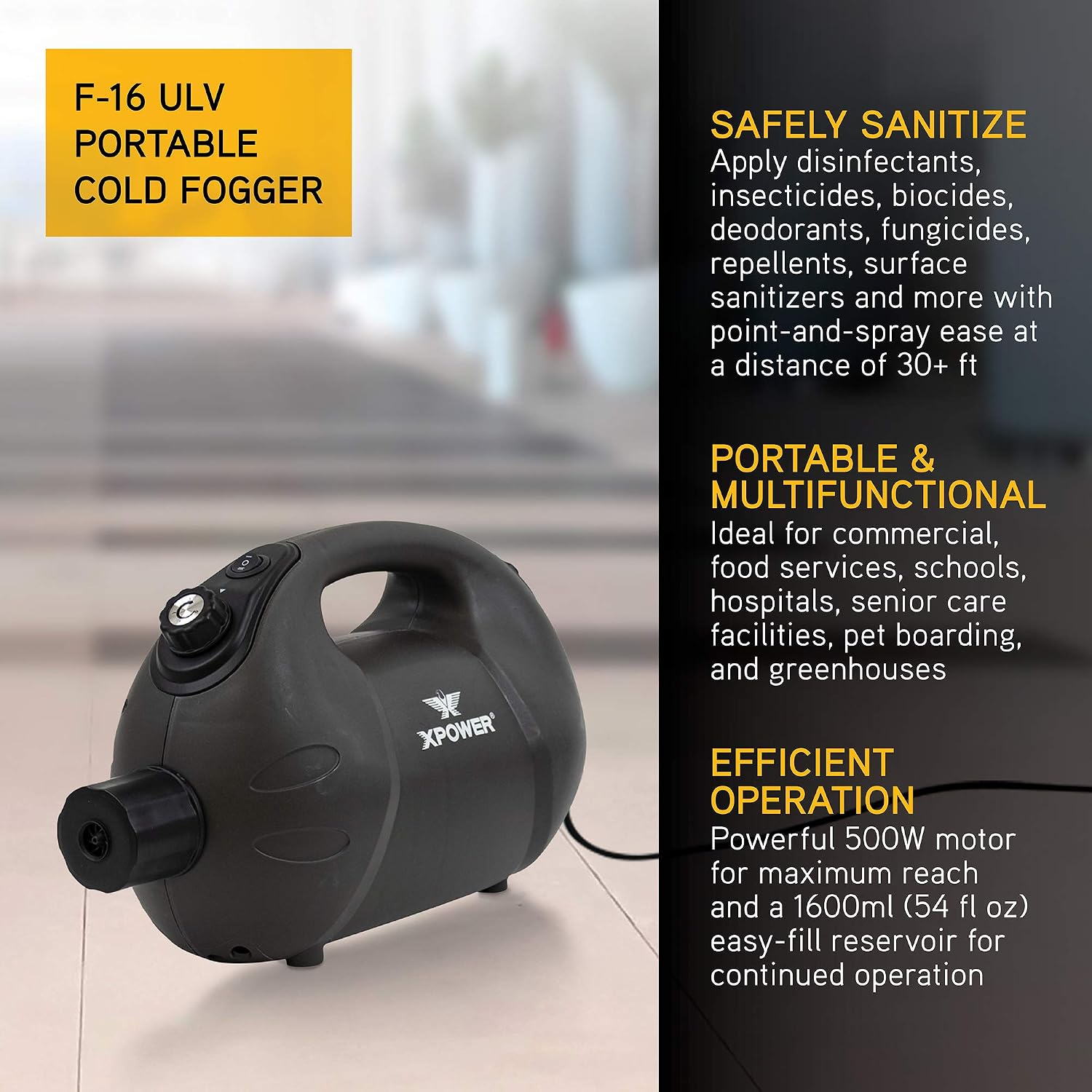
XPOWER
$217.81
In stock on Amazon
Check price on AmazonCordless ULV Foggers: Job-Site Flexibility With a Runtime Ceiling
The value of cordless is real and underrated in disinfection work: you can fog bathrooms, closets, attic crawlspaces, and stairwells without hunting for outlets or running extension cords across wet floors. The tradeoff is runtime per charge, output consistency as the battery depletes, and long-term battery replacement cost in fleet use.
The SWANSOFT has attracted genuine commercial-tier operators. A medical professional documented using it for Hypochlorous Acid disinfection and describes the output as commercial-grade performance at a consumer price point. The loudness is consistent and worth passing along to clients who expect a quiet process — it is not a quiet machine. For HOCl specifically, battery-powered operation removes one variable: you’re not dragging a cord across clinical or food-service floors where cord management creates its own contamination risk. HOCl’s mild corrosivity profile is manageable in most cordless units with plastic or stainless wetted parts; verify before buying by checking your unit’s wetted-parts specification against your HOCl concentration, as advised by the NPIC Disinfectants and Sanitizers General Fact Sheet.
The Hurricane Ultra II requires an honest assessment. A documented buyer who logged 10 uses before failure, followed by a negative warranty resolution experience, is not a data point to bury. For a solo operator doing occasional disinfection jobs, 10 uses before failure is a liability. For a fleet manager evaluating unit longevity, it’s a serious total-cost-of-ownership signal. This doesn’t mean every unit fails at 10 uses — manufacturing variance is real — but it means you should not purchase the Hurricane Ultra II for any application where machine failure mid-job creates a significant operational or contractual problem until the manufacturer demonstrates improved warranty resolution.
Cordless ULV Runtime Reality Check:
- Typical cordless ULV battery capacity: 2,000–4,000 mAh
- Estimated real-world runtime at medium output: 45–90 minutes per charge
- Typical indoor disinfection treatment (2,000 sq ft): 20–40 minutes
- Practical takeaway: one charge covers most single-location jobs; multi-location routes require spare batteries or a corded backup
Createch
In stock on Amazon
Check price on AmazonElectrostatic Foggers: When Surface Wrap Changes the Outcome
Electrostatic fogging is a genuinely different mechanism, not just a marketing tier. The machine imparts an electrical charge (typically positive) to droplets as they exit the nozzle. Surfaces — which carry a natural negative charge — attract the charged droplets, pulling the mist around curves, under shelves, onto the backs of chairs, and into surface geometry that gravity-settling fog simply misses. The CDC Environmental Infection Control Guidelines discuss aerosol-generating device behavior in surface coverage contexts and note the relevance of droplet deposition mechanics for achieving adequate surface contact with disinfectants. For complex surface environments — medical waiting rooms, restaurant dining areas, school classrooms — the electrostatic advantage is documented and operationally meaningful.
The Hurricane ES is the machine in this comparison that has attracted distinctly professional reviewers: cleaning business operators and first responders who identify the electrostatic charging as the operational differentiator for their disinfection work. The wrap effect on seating, equipment, and three-dimensional surfaces reduces the operator time needed to achieve adequate coverage compared to a conventional fogger that deposits from above only. For a cleaning contractor whose labor cost per square foot is the margin variable, that coverage efficiency has direct P&L impact.
The tradeoff: electrostatic units add mechanical complexity (the charging electrode), are more sensitive to certain chemical formulations (ionic surfactants can interfere with charge retention), and tend to cost more than equivalent-output conventional foggers. For mold remediation specifically, where you’re driving penetrant into porous materials rather than coating hard surfaces, the electrostatic advantage diminishes — and a conventional ULV at the right particle size and output rate may outperform an electrostatic unit at a lower price point.
Per PCT Online’s coverage of ULV application technology in pest management (Pest Control Technology magazine), the electrostatic mechanism’s benefit is most pronounced on complex, irregular surface geometry and least significant on open, flat surfaces or penetration-focused applications. That framing applies directly to the disinfection vs. mold remediation question: complex surface environments favor electrostatic; penetration-focused applications favor conventional ULV with fine particle settings.
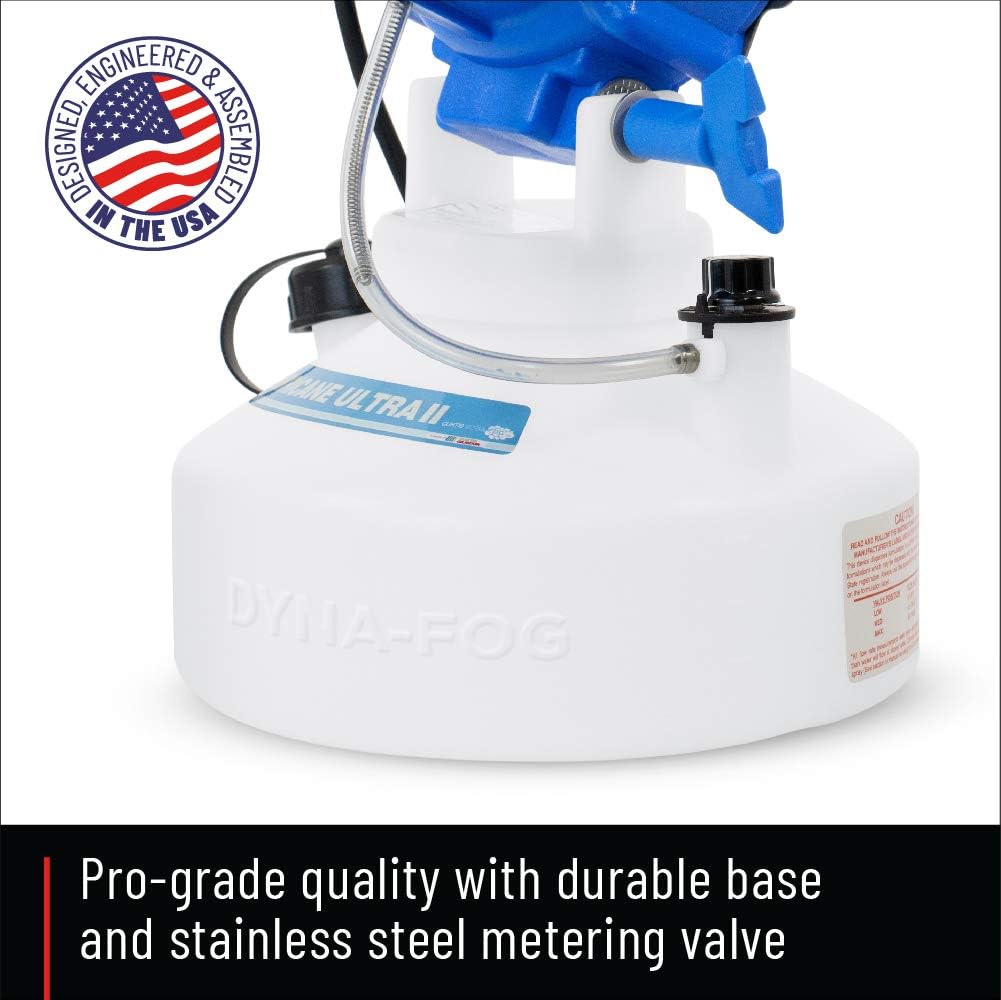
Hurricane
$382.99
In stock on Amazon
Check price on AmazonDecision Framework: Matching Machine to Application
If your primary application is indoor disinfection of complex surface environments (medical, food service, schools): The Hurricane ES’s electrostatic differentiation is worth the price premium. Surface wrap reduces labor time per location, and professional reviewers in exactly this context call out the charging mechanism as operationally meaningful.
If your application is mold remediation with penetrant products like Concrobium: A corded ULV at adjustable particle size — the XPOWER F-16 for heavier commercial volume, or the Createch Commander for smaller residential scope — matches the job better than electrostatic. Budget separately for application protocol documentation since the Commander’s manual won’t carry you; source guidance from the chemical manufacturer directly.
If you’re doing HOCl disinfection in clinical or food-service environments where cord management is a real constraint: The SWANSOFT’s cordless operation and documented HOCl compatibility make it the logical evaluation unit. Verify wetted-parts materials against your specific HOCl concentration before committing at volume, following NPIC Disinfectants and Sanitizers General Fact Sheet guidance on corrosivity matching.
If you’re evaluating a warranty-backed unit for fleet use: Do not shortlist the Hurricane Ultra II until the manufacturer has visibly improved warranty resolution. The documented failure-at-10-uses report is a fleet liability.
If primary use is outdoor pest control with occasional disinfection: The Smith ULV covers the pest application well. For disinfection, treat it as a secondary capability and verify chemical compatibility for each specific formulation before use.
Particle Size by Application: Quick Reference
According to PCT Online’s ULV application technology guidance and corroborated by EPA Minimum Risk Pesticide registration documentation for product use instructions, particle size targeting by application breaks down as follows:
- Mold remediation penetrants: 20–40 micron VMD to carry adequate active ingredient into porous material without over-wetting
- Airborne disinfection (targeting pathogens in the air column): 5–15 microns for maximum hang time
- Surface disinfection: 20–30 micron range; electrostatic charging can compensate for slightly larger VMD on complex surfaces
- Pest control insecticide application: 10–30 microns depending on active ingredient and target pest
Frequently Asked Questions
What is the difference between a regular ULV fogger and an electrostatic fogger for disinfecting? A standard ULV fogger creates fine droplets that float through air and settle via gravity onto surfaces directly in the fog’s path. An electrostatic fogger adds an electrical charge to those droplets, causing them to be attracted to surfaces — including undersides, backs, and curves that gravity-settled fog never reaches. The CDC Environmental Infection Control Guidelines address aerosol-generating device behavior and note how deposition mechanics affect surface coverage outcomes. For complex surface environments, electrostatic coverage is meaningfully more thorough. For open-air or penetration-focused applications such as mold remediation into wall cavities or outdoor pest control, the electrostatic advantage largely disappears.
Can I use Hypochlorous Acid in any ULV fogger or does it require a specific machine? HOCl is mildly corrosive and not compatible with all wetted-part materials. Brass fittings and certain elastomers degrade faster with regular HOCl exposure. Machines with stainless steel or fully polypropylene and HDPE fluid pathways are significantly more durable for HOCl use. The NPIC Disinfectants and Sanitizers General Fact Sheet (National Pesticide Information Center, Oregon State University) advises checking the fogger’s wetted-parts specification against your disinfectant’s active ingredient and concentration before committing to a machine for that workflow.
How do I know what particle size to use for mold treatment vs. pest control vs. disinfection? As a working rule: mold remediation penetrants benefit from 20–40 micron VMD; airborne disinfection favors 5–15 microns for maximum hang time; surface disinfection sits in the 20–30 micron range; pest control typically targets 10–30 microns depending on the active ingredient and target pest. PCT Online’s ULV application technology coverage (Pest Control Technology magazine) provides a more detailed breakdown by active ingredient class for pest management applications.
How long does a cordless ULV fogger battery last per charge in real use? Expect 45–90 minutes at medium output settings depending on battery capacity and motor load. Most single-location commercial disinfection treatments covering 2,000–4,000 square feet fall within one charge cycle. Multi-location routes require either a corded unit or spare charged batteries — plan for two to three batteries per technician for a full workday of cordless operation.
Is the Createch Commander powerful enough for a whole-house mold treatment or only small spaces? Operator reports suggest the Commander handles residential spaces adequately — single rooms through moderate-sized homes — but operators document needing to run it in stages through large or compartmentalized floor plans. For a whole-house treatment involving multiple stories, attic space, and basement simultaneously, a higher-output corded unit with greater hose reach is a more efficient tool. The Commander’s larger constraint is the documentation gap: plan your application protocol from external sources — Concrobium’s own application guidance, for example — rather than relying on the included manual.
What should I do when a ULV fogger stops suctioning up liquid after a few months of use? Loss of suction is most commonly caused by: a clogged or collapsed intake tube (inspect and clear); mineral or chemical deposits on the nozzle tip or check valve (disassemble and soak in appropriate solvent per the chemical manufacturer’s guidance); or a worn or cracked impeller (a parts-availability question that varies by brand). Before assuming a major repair, run a clean-water flush cycle immediately after every chemical use. For oxidizing disinfectants like HOCl or bleach-based formulas, a distilled-water flush followed by a dilute citric-acid rinse cycle prevents deposit buildup that causes exactly this failure mode.