September 30, 2026 • Elena Garcia • 10 min reading time • Specs verified June 25, 2026
Smoke, Pet Odors, and Mold Smells: Using Thermal Foggers and Odor Counteractants the Right Way
Smoke, mold, and pet odors all share one frustrating trait: they hide inside porous surfaces, not just in the air. A thermal fogger — a device that uses heat to vaporize liquid chemical solutions into an ultra-fine dry mist capable of penetrating soft materials, cracks, and HVAC cavities — sounds like the perfect weapon. And it can be. But experienced operators are unanimous on one point: if you fog before you’ve dealt with the odor source, you’re spending money to temporarily mask a problem that will fully resurface within days or weeks. That’s the anchor principle for everything in this article. Get the source, then fog. After that, your choice of counteractant (a chemical formulated to chemically neutralize odor molecules rather than simply perfume over them) and fogger type will determine whether your result lasts a week or a year.
This guide is written for practitioners who are somewhere between “I just bought a fogger” and “I’ve done a dozen treatments but I’m not satisfied with longevity.” We’ll cover the source-first workflow, the thermal-versus-electric decision, counteractant chemistry and product selection, crawlspace and vehicle procedures, and the real cost math on the consumables.
The Non-Negotiable First Step: Source Removal Before You Ever Fire Up the Fogger
An automotive reconditioning professional with 25 years of experience — cited across multiple verified buyer review threads — states this plainly: fogging alone over an untreated odor source does not produce lasting results. It doesn’t matter how good your counteractant is or how fine the droplet distribution is. Odor molecules continuously off-gas from the substrate — the nicotine-saturated headliner, the pet urine soaked into subflooring, the active mold colony behind the drywall — and they will overwhelm any counteractant residue within days.
The source-first checklist before fogging:
- Smoke (vehicle or room): Extract and dispose of contaminated cabin filters, trunk liners, or in severe cases, seat foam. Wipe all hard surfaces with an appropriate enzymatic or oxidizing cleaner. In hotel or residential rooms, remove window treatments and wash them separately if feasible; they’re among the heaviest smoke absorbers.
- Pet odors: Enzymatic cleaners (urea-digesting enzymes) applied directly to the stain, with full dwell time, before fogging. Fogging on top of dried urine that hasn’t been enzymatically treated is purely cosmetic.
- Mold: Per EPA indoor air quality guidance on mold remediation, the moisture source must be corrected and visible mold physically removed before any chemical treatment is applied. Fogging an active mold colony that’s still wet and feeding is wasted chemistry.
Only after source remediation does fogging make sense as a finishing step — and at that point, it works extremely well.
Thermal vs. Electric (Cold) Fogger: Which One for Interior Odor Work?
This is where a non-obvious finding trips up a lot of buyers. A verified owner who runs both a propane thermal fogger and an electric cold fogger — specifically the OdoBan Fogmaster Jr. — made the switch to the electric unit for indoor odor work for a very specific reason: propane combustion inside an enclosed space produces its own odor compounds, and those combustion byproducts can chemically interact with your counteractant and leave behind a smell that clients notice. You’ve eliminated the cigarette smoke and introduced a faint exhaust note. That’s a bad trade.
The practical decision rule:
| Scenario | Preferred Fogger Type | Why |
|---|---|---|
| Interior rooms, vehicles, hotel suites | Electric cold fogger or electric thermal | No combustion byproducts in the treated space |
| Crawlspaces, attics (well-ventilated entry possible) | Either — propane acceptable with ventilation protocol | Source is not fully enclosed during treatment |
| Large exteriors, abandoned structures | Propane thermal | Combustion dilutes rapidly; output volume justifies the format |
| HVAC duct treatments | Electric cold fogger only | Propane flame risk in ductwork |
This doesn’t mean propane foggers have no place in odor work — they do, especially in larger structural treatments where you need volume. But for the bread-and-butter hotel room, vehicle interior, or residential smoke job, the electric format eliminates a variable that experienced operators consistently flag as a problem.
Counteractant Selection: What the Chemistry Actually Does
“Odor counteractant” covers a spectrum. The low end is perfume-based masking — it adds a stronger smell to overpower the offensive one. The professional tier uses true chemical neutralization: reactive molecules (often pairing agents or cyclodextrin-based compounds) that bond to odor molecules and render them non-volatile, meaning they can no longer reach your olfactory receptors. This is what you want for smoke, mold, and pet work.
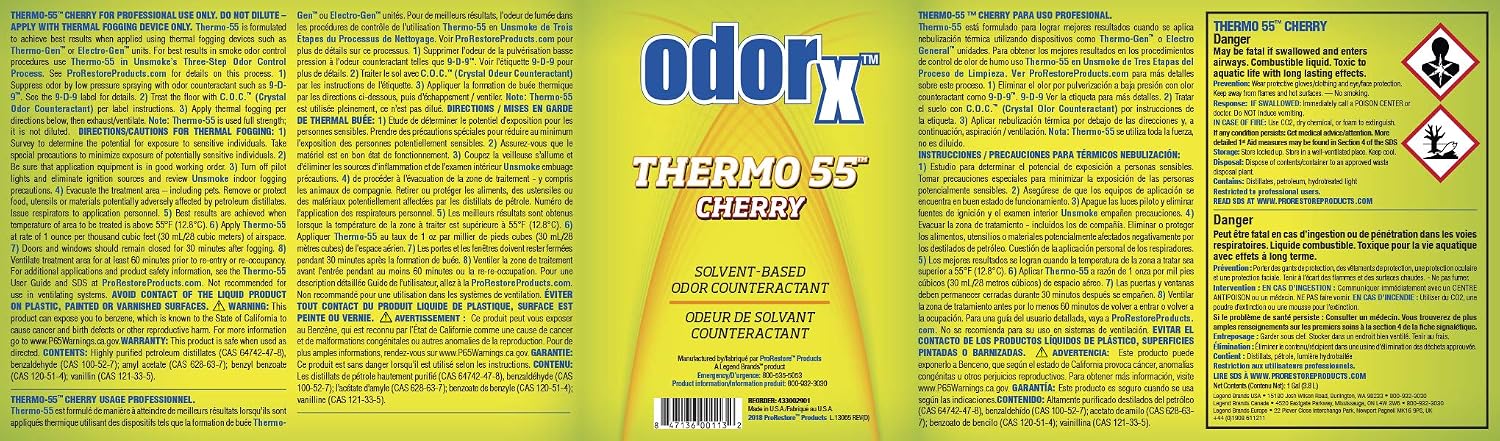
ODORx Thermo-55 is the most commonly cited professional-grade thermal counteractant in this application category. It’s formulated specifically for thermal foggers — the heat-vaporization process is part of how it achieves the fine particle distribution needed to penetrate porous materials. A hotel restoration professional using it in guest rooms describes it as highly effective for marijuana and tobacco smoke, with results that hold across turnover cycles when the source prep was done correctly.
The one legitimate criticism — and it deserves honest treatment — is the cost-per-volume ratio. A two-star review from a buyer citing the cost versus quantity received is not wrong. At mid-2026 pricing, Thermo-55 runs roughly $40–$55 per quart depending on where you source it, and a single hotel room treatment can consume 4–8 ounces of product. For a single-unit operator doing occasional jobs, the math is fine. For someone running 15–20 smoke remediation jobs a month, you’re looking at a meaningful consumable line in your P&L, and bulk purchasing or a distributor relationship matters.
Can you use Thermo-55 in a cold ULV fogger? No — and this is addressed in detail in the FAQ section below. The short answer is that Thermo-55’s formulation is designed for thermal application; using it cold changes particle behavior and chemistry in ways that reduce effectiveness.
Concrobium Mold Control is the other counteractant that appears repeatedly in crawlspace and attic mold treatments. It works through a different mechanism: as it dries, it forms a rigid polymer layer that physically crushes mold spores and leaves an antimicrobial residue that inhibits regrowth. A Createch Commander crawlspace user provides the most practically useful procedural detail in this category: start at medium flow, then dial back to low once you’ve established distribution, and rely on the Concrobium manufacturer’s application video rather than the instructions that come in the box. The included instructions underspecify flow rate for enclosed low-clearance spaces, and overfogging in a crawlspace leads to wood saturation — which creates a secondary moisture problem. This is actionable, non-obvious guidance.
Crawlspace and Tight-Space Technique
Crawlspace fogging introduces constraints that room fogging doesn’t. You often can’t stand upright, your fogger needs to work at severe angles, and the consequences of over-application (wood saturation, elevated moisture content) are worse than under-application.
The Longray fogger is cited by multiple crawlspace operators for one specific physical feature: it can fog at nearly horizontal angles, which is mechanically necessary in spaces with 18–24 inch clearance. Most foggers are designed to operate within about 45 degrees of vertical; forcing them horizontal causes fuel or liquid delivery problems. If you’re specifying equipment for crawlspace work, this isn’t a nice-to-have — it’s a functional requirement.
Flow rate guidance for wood-framed crawlspaces:
- Start at medium flow and fog in sweeping passes
- Dial to low for sustained coverage in any one zone
- Target: surfaces appear faintly misted, not visibly wet
- Dwell time before re-entry: minimum 2 hours with ventilation fans running after treatment; 4 hours preferred for mold counteractant applications
Per the Concrobium manufacturer’s documentation, the product needs to dry completely to form its active polymer layer — wet conditions during drying defeat the mechanism.
The Numbers: What a Realistic Treatment Actually Costs
By the numbers — ODORx Thermo-55 mid-2026 benchmarks:
- Hotel room (400 sq ft): 4–6 oz of counteractant, 10–15 min treatment time
- Full-size SUV interior: 2–3 oz, 5–8 min treatment time
- 1,000 sq ft residential (light smoke): 8–12 oz, 20–30 min with repositioning
- Crawlspace (1,200 sq ft, Concrobium): 16–24 oz, two-pass technique
At ~$48/qt (16 oz) mid-market pricing, a hotel room treatment runs $12–$18 in product cost, before labor and equipment amortization. A vehicle treatment runs $6–$9. These are margins that work in a mobile service model, but they do require honest source-prep time that doesn’t compress well if you’re pricing jobs at fixed flat rates without accounting for prep labor.
Frequently Asked Questions
Will thermal fogging actually eliminate cigarette smoke smell or just cover it up temporarily? It depends entirely on whether the source was treated first. Thermal fogging with a true chemical counteractant — not a perfume-based product — will neutralize airborne and surface-absorbed odor molecules that weren’t removed by cleaning. If the source (contaminated foam, saturated drywall, ductwork buildup) is still present and off-gassing, the effect is temporary by definition. When source prep is complete, thermal fogging results from operators using products like ODORx Thermo-55 consistently hold across multiple weeks.
Can I use ODORx Thermo-55 in a cold ULV fogger or does it require a thermal fogger? Thermo-55 is formulated for thermal application. The heat cycle is part of how the active chemistry is dispersed and how particle size is controlled. Using it in a cold fogger produces larger, wetter droplets and doesn’t activate the formulation the same way. If you’re running a cold ULV fogger, look for counteractants specifically labeled for cold-fogging or water-based ULV application — several manufacturers offer format-matched versions.
How long do I need to leave a room after fogging before it is safe to re-enter? For most interior odor counteractant applications, 30–60 minutes with the space sealed, followed by ventilation before re-entry, is the standard protocol. Mold-specific treatments using products like Concrobium require longer dwell time — 2–4 hours — because the drying cycle is the active mechanism. Always read the SDS (Safety Data Sheet) for your specific product; some counteractants contain sensitizing compounds that require full respiratory PPE during application and ventilation clearance before unprotected re-entry.
What is the correct flow rate setting when fogging a crawlspace to avoid soaking the wood? Based on Concrobium’s manufacturer application documentation and operator experience compiled in verified reviews: start at medium, move to low once initial distribution is established. The target is a light, visible mist on surfaces — not visible droplet accumulation or pooling. In low-clearance spaces, the enclosed volume means chemistry builds faster than you expect, and over-application is a real risk. The Createch Commander user’s guidance to rely on the manufacturer’s video tutorial rather than box instructions is worth taking seriously.
Can I use a propane fogger for interior odor treatment or will the propane smell create a new problem? Propane combustion inside a sealed interior space introduces combustion byproducts — aldehydes, CO, and other compounds — that can both create a perceptible odor and chemically interact with your counteractant. Experienced operators who have used both formats for interior work consistently report better client results from electric foggers in enclosed spaces. Reserve propane thermal units for well-ventilated or exterior applications.
How many gallons of counteractant does a typical hotel room or vehicle treatment require? Much less than most buyers expect. A standard hotel room (350–450 sq ft) typically requires 4–6 ounces of thermal counteractant with a properly calibrated fogger. A full-size vehicle interior requires 2–3 ounces. Over-application wastes product and can leave a sticky residue on surfaces. Start conservatively — you can always run a second pass, but you can’t un-fog a soaked headliner.