August 20, 2026 • Elena Garcia • 11 min reading time • Specs verified June 25, 2026
Portable and Battery-Powered Misting Systems for Events, Boats, and Off-Grid Cooling
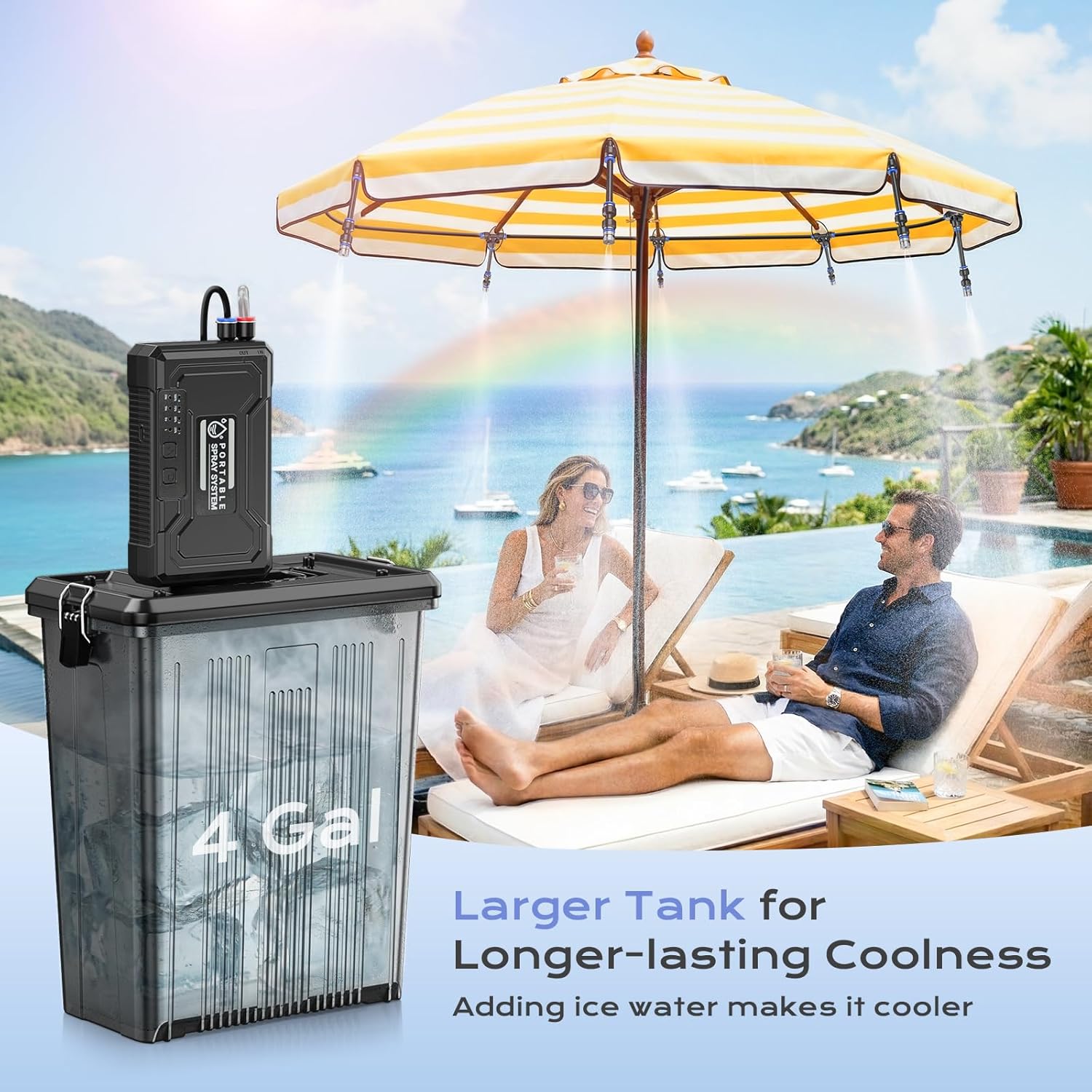
A misting system works by pushing water through small nozzles that break the liquid into a fine spray — droplets tiny enough to evaporate quickly and pull heat out of the surrounding air as they do. Plug-in versions need a garden hose or plumbed water line, which rules them out for boats, pop-up events, roaming greenhouse carts, and anything truly off-grid. That’s where battery-powered and self-contained portable misters come in: they carry their own water reservoir and run off a rechargeable battery pack, so the only thing you need is a flat surface and a warm afternoon. If you’re currently sourcing equipment for an event rental fleet, a marine application, or a permanent-but-portable greenhouse cooling setup, this guide is for you — we’ll cover how the specs actually translate to real-world performance, where the category earns its price premium, and where the marketing copy gets ahead of reality.
| EDITOR'S PICKOrbit Arizona Mist 92100 Booste… | Mid-tierBluepro 50FT Portable Misting S… | Budget pickAusic Portable Misting System | |
|---|---|---|---|
| Tank size | — | 5.8 gal / 22L | 9L |
| Battery | — | 5200mAh | — |
| Runtime | — | — | 8 hrs |
| Hose length | — | 50 ft | — |
| Nozzles | — | 8 | — |
| Water resistance | — | IPX8 | — |
| Price | $128.99 | $59.99 | $42.49 |
| See on Amazon → | See on Amazon → | See on Amazon → |
How the Hardware Actually Works — and Where the Spec Sheet Lies
Most battery-powered misting systems use a small 12V submersible or centrifugal pump to pull water from a reservoir (typically 4–12 liters in consumer units, up to 20L in prosumer configurations) and push it through a hose to one or more brass or plastic nozzles. The pump runs off a lithium-ion battery pack rated in milliamp-hours (mAh) — a measure of stored charge. A 15,000 mAh pack sounds substantial, but actual pump draw varies between 1.5A and 4A depending on the unit, which means real runtime ranges from roughly 2 to 6 hours at continuous operation. More on that math in the FAQ below.
The most important variable the marketing materials routinely obscure is operating pressure. Effective evaporative cooling requires droplets in the 10–50 micron VMD (volume median diameter) range — small enough to evaporate before hitting skin or fabric. Consumer battery misters typically operate at 40–80 PSI; at that pressure range with standard 0.012” orifice nozzles, you’re producing droplets in the 50–150 micron range. That’s adequate for open-air events and moving environments like boat decks, but it’s at the upper edge of what works in still, humid air. The University of California Davis Extension publication on evaporative cooling systems notes that droplet size below 50 microns is the threshold for genuine air-temperature reduction rather than simple surface wetting — a useful benchmark when evaluating whether a portable unit’s spec sheet pressure actually delivers cooling or just a wet mist.
Nozzle count matters disproportionately. Every nozzle you add is a parallel flow path drawing from the same fixed-displacement pump. Battery-powered pumps are not pressure-regulated the way high-pressure misting systems are — they’re volume-limited. Owners consistently report pressure drop-off when running more than 4–6 nozzles from consumer-grade units, which typically spec at 0.3–0.5 GPM total flow. If you’re planning an event tent with 20 nozzle drops, a battery pump will not serve you. Recognize the use case ceiling early.
Real-World Deployments That Actually Work (and One That Requires Adaptation)
Event and hospitality use: Portable misting systems shine in pop-up event contexts — farmers markets, outdoor weddings, craft fairs, tailgates — where you need self-contained cooling that can be repositioned between setups. Units like the Hessaire MC37M or comparable reservoir-based systems are designed with handle carry and quick-connect hose fittings that simplify tent-to-tent deployment. For event rental operators, the key procurement decision is reservoir size relative to event duration. At average output, a 9-liter reservoir runs roughly 4–6 hours; a 12-liter unit pushes closer to 8 hours unattended. The practical workaround used by experienced operators — reported independently across multiple buyer reviews — is substituting the included reservoir bucket with a larger external container (a 20–33 gallon food-grade trash container works well) connected via standard 3/8” tubing. This is a documented field modification, not a warranty-voiding hack; the pump simply draws from whatever vessel you connect it to, provided the inlet fitting matches.
Marine and open-water applications: Boat owners report specific advantages that don’t show up in land-based reviews. On open water in direct sun, the combination of wind-assisted evaporation and mist output creates a measurable comfort differential. Reviewers of the Ausic 9L system describe effective cooling across a wide cockpit in full-sun conditions — a use case where the moderate droplet size is actually an asset because ambient airflow handles evaporation that still air wouldn’t. Salt-spray environments introduce a different concern: nozzle clogging from mineral deposits. Any portable system used in a marine environment should have brass nozzles rather than plastic, and a weekly flush with clean fresh water is a minimum maintenance cadence.
Golf cart and vehicle cooling: An emerging niche in the owner review record is portable misting mounted to open-top vehicles — golf carts, ATVs, and side-by-sides used in agricultural and turf management contexts. The application logic is sound: the vehicle’s motion creates airflow that dramatically improves evaporation efficiency, and a 6-liter reservoir lasts an entire 18-hole round or a full field inspection circuit. Reviewers on multiple platforms independently describe this configuration as “surprisingly effective,” which tracks with the physics — moving air is the misting system’s best friend.
Pet cooling in extreme heat: One particularly practical application that surfaces in aggregated review data is cooling working and sporting dogs in hot climates. A Bluepro unit owner in the Southwest describes using the system to cool a Great Pyrenees — a breed with a heavy double coat that traps heat and makes warm-weather work genuinely dangerous. The mist-on-coat approach works because the dog’s fur acts as a wick, holding moisture while evaporation cools the skin beneath. This is a legitimate application with animal welfare implications, and it’s worth flagging for event operators who handle animals (equestrian events, dog shows) or agricultural workers managing livestock in high-heat conditions.
Greenhouse supplemental cooling: A greenhouse owner’s documented modification — replacing the stock 4-gallon bucket with a 33-gallon trash container — addresses the single biggest limitation of portable misting in cultivation environments: runtime. All-day greenhouse cooling, especially in a propagation house where humidity management matters, demands 8–12+ hours of continuous or duty-cycled operation. The large-reservoir mod makes that feasible without a plumbed system. Greenhouse Grower’s equipment comparison coverage consistently notes that the cost gap between a DIY portable setup and a plumbed low-pressure system narrows significantly when you factor in installation labor — the portable approach remains competitive for growers in leased spaces or seasonal high tunnels.
The Orbit Booster Pump: Thermal Shutoff Is a Feature, Not a Defect
If you’re operating or specifying the Orbit booster pump system, one behavior in the owner review record deserves explicit attention: the unit periodically shuts off automatically and restarts after a short interval. This is thermal protection logic built into the motor controller — when the pump motor reaches a set temperature threshold (typically 60–70°C internal), it cycles off to cool before restarting. In practice, this means a 30–90 second interruption in misting output during peak-demand operation in very high ambient temperatures.
A meaningful fraction of confused negative reviews on this product stem from owners who interpreted this behavior as malfunction and returned working units. It is not a defect. This Old House’s outdoor misting system guide notes that thermal protection cutoffs are standard in small-motor pump designs for exactly this reason — sustained duty cycles in 100°F+ ambient temperatures push motor temperatures toward limits quickly. If you’re deploying these units at outdoor events in Phoenix, Las Vegas, or similar climates, brief the staff running the setup so they understand the restart will happen automatically. Plan for the interruption rather than fighting it.
By the numbers — portable system capacity benchmarks:
| Reservoir Size | Avg Runtime (continuous) | Max Nozzles (before pressure drop) | Best Use Case |
|---|---|---|---|
| 4–6 L | 2–4 hrs | 3–4 | Golf cart, small patio |
| 9–12 L | 4–7 hrs | 4–6 | Boat deck, event booth |
| 20–33 L (modified) | 10–16 hrs | 4–6 | Greenhouse, full-day events |
Decision Framework: If X, Then Y
If you’re cooling a single event booth or vendor tent for a full-day outdoor market, the 9–12L self-contained units hit the sweet spot. Runtime covers most event windows without mid-day refills, and the portability premium is worth it versus renting plumbed infrastructure.
If you’re running an event rental fleet and need units that can survive 3–4 events per weekend across multiple operators, prioritize brass nozzles, aluminum reservoir fittings, and a brand with domestic parts availability. Good Housekeeping’s 2025 portable cooling review highlights that plastic fitting failures are the primary failure mode in rental-tier portable misters — the spec gap between budget and mid-range units shows up in the fittings, not the pump.
If you’re on a boat, prioritize a unit with IP55 or better water resistance rating on the pump housing, and go brass on every nozzle. The marine environment will find every plastic weak point within one season.
If you’re supplementing greenhouse cooling in a leased or temporary structure, the large-reservoir modification is worth doing from day one. Don’t fight the 4-gallon reservoir limitation — connect to a 20–33 gallon food-grade container and treat the pump as permanently installed hardware pulling from a staging tank.
If the application requires more than 6 nozzles at consistent pressure, a battery-powered pump is the wrong tool. Step up to a 12V DC high-pressure pump (120+ PSI) with a dedicated power supply, or evaluate a plumbed low-pressure system.
Frequently Asked Questions
How long will a 15,000 mAh battery actually run a misting system at normal output? At typical pump draw of 2–3A (24–36W at 12V), a 15,000 mAh / 55.5Wh battery delivers roughly 1.5–2.5 hours of continuous runtime at full output. Some units reduce pump speed at moderate mist settings, extending this to 3–4 hours. Battery capacity claims on portable misters are often stated at the cell level before conversion losses — real-world runtime runs 20–30% shorter than the theoretical maximum.
Can I add ice to the water reservoir to make the mist colder, and does it help in humid climates? Yes, and it works — with caveats. Ice lowers water temperature, which reduces the vapor pressure of the droplets slightly, giving the mist a cooler initial feel on skin. Multiple reviewers report this modification independently across different products, confirming it’s a genuine field practice. However, in high-humidity climates (above 60% RH), evaporative cooling efficiency drops sharply regardless of water temperature. Ice helps most in dry climates where the mist evaporates quickly; in humid air, it’s a marginal improvement on an already limited system.
What is the maximum number of nozzles I can run from a battery-powered pump before pressure drops? Most consumer-grade battery pumps (0.3–0.5 GPM, 40–80 PSI) will sustain adequate pressure through 4–6 nozzles with standard 0.012” orifice tips. Beyond 6 nozzles, pressure at the far end of the line drops noticeably. If your layout requires more coverage, use a manifold to ensure even distribution across the available nozzle count rather than extending a single run.
Can these portable systems run off a larger external water container instead of the included bucket? Yes. The pump inlet on most systems uses standard 3/8” or 1/2” tubing, and owners regularly connect to 20–33 gallon food-grade containers to extend runtime dramatically. The pump draws from whatever vessel you connect — no modification to the pump itself is required, only a matching inlet hose. This is a well-documented field modification, not a workaround.
Is the Orbit booster pump safe to leave running unattended, and what triggers the automatic shutoff? The Orbit system includes thermal protection that cuts power to the motor when internal temperature reaches threshold, then automatically restarts. This is a designed-in safety feature. Leaving it running unattended is generally safe in terms of fire or electrical risk, but monitor the reservoir level — running the pump dry repeatedly shortens motor life. In very high ambient temperatures, expect periodic 30–90 second rest cycles.
How do I prevent clogging in a portable misting system when using it with hard tap water? Hard water (high mineral content) deposits calcium and magnesium at nozzle orifices, which are only 0.012”–0.020” in diameter — a small deposit creates a meaningful restriction. Prevention: use filtered or softened water when possible; flush the system with clean water after each use; soak nozzles in white vinegar for 30 minutes monthly. Brass nozzles are more resistant to mineral damage than plastic. If your water supply is particularly hard (above 200 ppm TDS), a simple inline sediment filter upstream of the pump extends nozzle life significantly.