September 1, 2026 • Elena Garcia • 9 min reading time • Specs verified June 25, 2026
Integrated Mosquito Control: Dunks, Yard Sprays, and Foggers Working Together
Mosquitoes have a two-part life cycle, and that single fact explains why no one product ever quite does the job on its own. The larvae — the wriggly juvenile stage — live in standing water: rain barrels, clogged gutters, bird baths, planter saucers, anything that holds water for more than a few days. The adults, the ones actually biting you, rest in shade during the day — deep in shrubs, under dense groundcover, along fence lines — and come out to feed at dusk and dawn. Control the larvae and you reduce the next generation. Kill the adults and you get relief tonight. Use a residual spray and you extend that relief through the week. Do all three intelligently and you’ve broken the cycle in a way that no single product can. This article is a decision framework for layering those tools — Mosquito Dunks for larval control, concentrated residual sprays for perimeter protection, and propane thermal foggers for adult knockdown — calibrated to your yard size and how close you sit to standing water.
Understanding the Three Layers (and Why You Might Not Need All of Them)
Before buying anything, map your yard’s actual mosquito pressure. The UC Davis Extension integrated pest management guidelines make this point plainly: mosquito populations are almost always tied to identifiable breeding sites within roughly 300 feet of where you’re getting bitten. That’s your diagnostic starting point.
Layer 1 — Larval control (Mosquito Dunks): If you have any standing water you can’t drain — rain barrels, ornamental ponds, low spots that collect water after rain — larval control is non-negotiable. Skipping it means you’re perpetually fighting adults that are being refreshed from your own yard.
Layer 2 — Residual spray (Cutter Backyard Bug Control or similar pyrethroids): If adults are resting and re-invading from adjacent properties, woods, or wetlands, a contact-plus-residual spray applied to shrubs, eaves, and fence lines creates a barrier they have to cross. This is the backbone of sustained protection between events.
Layer 3 — Adult knockdown fogger (Burgess or Black Flag propane fogger): If you have a specific event — a cookout, a garden party, a weekend of outdoor work — a thermal fogger gives you fast, broad knockdown of resting adults. It’s not a substitute for layers 1 and 2. It’s a short-duration amplifier.
The honest decision rule: small yard, no standing water, occasional outdoor use → Layer 3 only may be sufficient. Yard bordering a wooded area or drainage ditch, consistent outdoor living → you want all three working together.
Layer 1: Mosquito Dunks for Larval Sites
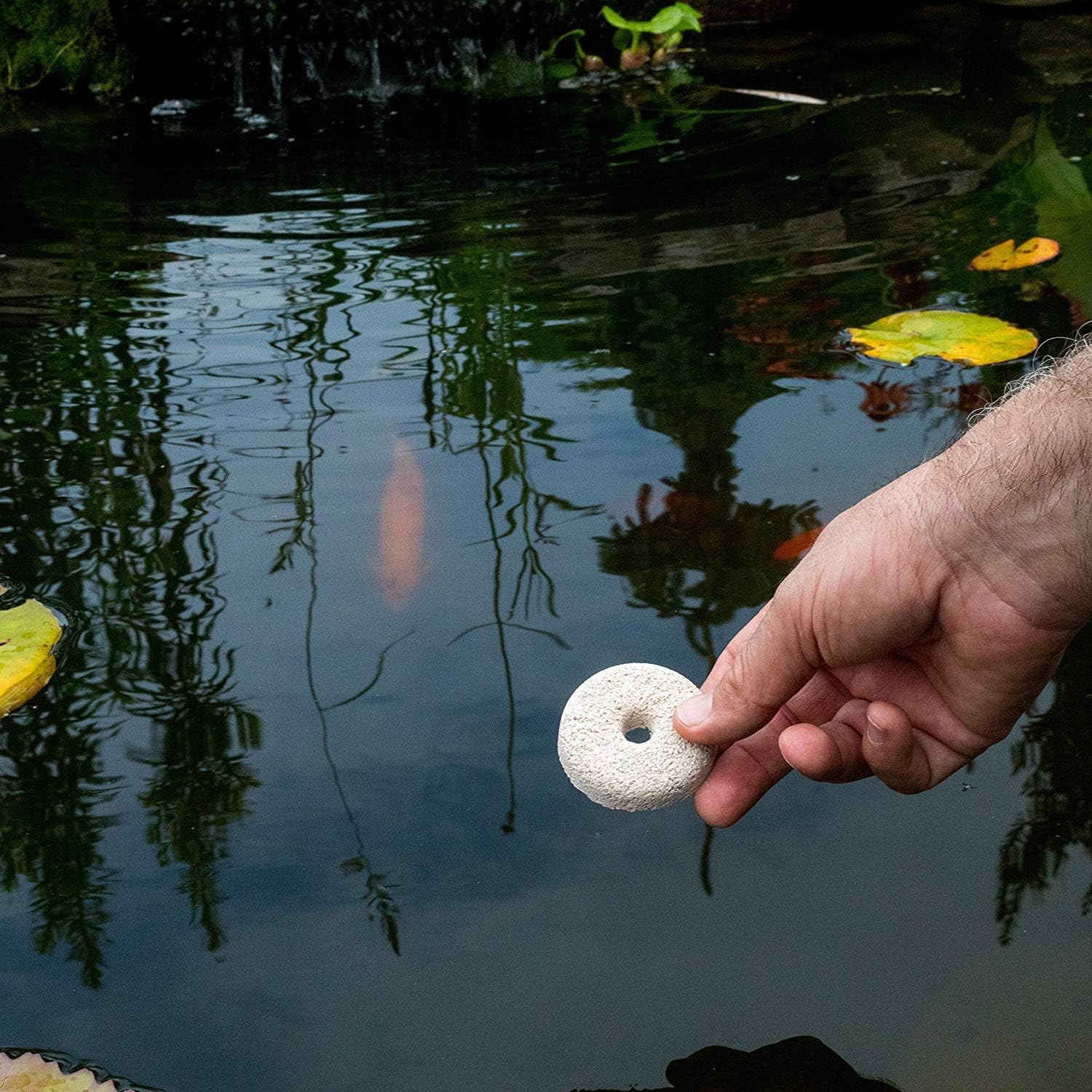
Mosquito Dunks contain Bacillus thuringiensis israelensis (Bti), a naturally occurring soil bacterium that produces proteins toxic to mosquito and fungus gnat larvae but — per the National Pesticide Information Center’s Bti fact sheet — essentially harmless to mammals, birds, fish, and beneficial insects including bees. That’s why owners consistently report using them confidently around pets, koi ponds, and edible gardens.
The small-container trick: A full dunk treats 100 square feet of water surface. For container plants and planter saucers, reviewers reliably report breaking dunks into quarter-sized pieces — one piece per small container — and seeing zero larvae in previously infested rain buckets within days. This makes a single pack of dunks go much further than the label suggests for homeowners dealing with scattered containers rather than large ponds.
Replacement schedule: Per the product label and consistent with Bti research cited in the NPIC fact sheet, dunks remain effective for approximately 30 days under normal conditions. In hot weather or high-flow situations (a rain barrel that overflows frequently), monthly replacement is the realistic expectation. Don’t count on longer.
Plant safety: Yes, you can use a dunk piece in a planter saucer. Bti has no plant-toxic mechanism. The only practical concern is overflow — if your saucer overflows into a planting bed, the dilute Bti solution won’t harm anything. The water itself, sitting and stagnating, is the problem you’re solving.
Layer 2: Residual Yard Sprays — Setting Realistic Expectations
Concentrated residual sprays — Cutter Backyard Bug Control is among the most widely reviewed in this category — work by coating leaf surfaces and ground-level harborage with a pyrethroid (typically lambda-cyhalothrin or similar) that kills on contact and degrades slowly over days to weeks. The operative phrase here is “degrades slowly” — not “lasts forever.”
By the numbers:
- Label claim for Cutter concentrate: up to 8 weeks
- Realistic reapplication window reported by owners: 3–4 weeks
- Effective window after rain event of >0.5 inches: often requires reapplication within 1–2 weeks
The 8-week label claim reflects ideal conditions — no rain, no UV breakdown, no foot traffic disturbing treated surfaces. Real yards don’t cooperate. Owners who track their reapplication intervals consistently land in the 3–4 week range, and several reviewers specifically note that stacking a second barrier product — applying two different pyrethroid formulations on alternating schedules — extends the effective window compared to relying on a single product alone. This aligns with what the EPA’s mosquito control guidance says about rotation to reduce localized resistance pressure.
Application technique matters more than product selection at this tier: Spray to the point of runoff on leaf undersides, fence lines, eaves, and the lower 2 feet of shrubbery. The CDC’s mosquito prevention guidance emphasizes that adult mosquitoes rest in cool, shaded, humid microclimates — leaf undersides and dense groundcover are where your spray concentration should be highest. A light surface mist on top of leaves accomplishes very little.
Layer 3: Propane Foggers for Adult Knockdown
Thermal propane foggers — the Burgess and Black Flag units are the most widely reviewed in the consumer-to-prosumer range — work by heating a pyrethrin-based insecticide solution to produce a visible fog of fine droplets (the “thermal” refers to the heat-generated droplet formation, not a temperature effect on the insecticide). Those droplets disperse through dense vegetation and knock down exposed adult mosquitoes on contact.
What foggers do well: Penetrating foliage canopy. Reviewers of the Burgess propane fogger consistently praise this specifically — the fog moves through dense shrubs in a way that a pump sprayer can’t easily replicate. For pre-event knockdown of resting adults in a heavily planted yard, a single pass 10–15 minutes before guests arrive produces meaningful results.
What foggers don’t do: Provide lasting protection. Across aggregated owner reviews, the realistic effectiveness window for a single fogging treatment is 2–6 hours — with perimeter re-fogging every 2 hours during extended outdoor events cited as the practical protocol for maintaining protection. Raid Yard Guard aerosol fogger reviewers report similar windows, with one Florida reviewer noting a consistent 8-hour window for that specific product — which outperforms typical propane fogger duration in that comparison, though the aerosol covers less total area per application.
Operational notes that buyers consistently learn the hard way:
- Burgess propane fogger: Requires match ignition (no push-button igniter). Owners flag this consistently. Have matches or a long lighter ready before you need them.
- Black Flag propane fogger: Requires a 2-minute warm-up period after lighting before the fog output becomes consistent. Starting and immediately walking the yard produces poor results; waiting the full warm-up produces the fog density owners praise.
Should you fog before or after applying a residual spray? Fog first. Here’s the logic: the fog knocks down adults present right now; the residual spray then coats surfaces for the follow-on protection window. If you spray residuals first and then fog, you risk physically dislodging some of the freshly applied residual with the fog application. Let the fog do its contact kill, wait 30–60 minutes for droplets to settle, then apply your residual to treated surfaces.
Re-entry interval: For aerosol foggers like Raid Yard Guard and OFF! Outdoor Fogger, label guidance and EPA registration data require waiting until the fog has dispersed and the treated area has ventilated — typically 15–30 minutes minimum before re-entry. Propane fogger insecticides carry similar re-entry language. Don’t rush this; the active pyrethrin concentrations in the fog are higher than in the settled residual.
Scaling the Stack to Your Yard
| Yard profile | Recommended layers |
|---|---|
| Small yard, no standing water, occasional use | Layer 3 only (propane or aerosol fogger, pre-event) |
| Medium yard, some containers, regular outdoor living | Layers 1 + 3 (dunks in containers, fogger for events) |
| Suburban lot with wooded border or drainage nearby | Layers 1 + 2 + 3 (full stack, 3–4 week spray rotation) |
| Property adjacent to pond, wetland, or field | Full stack, monthly dunk replacement, bi-weekly spray refresh |
The incremental cost of adding Layer 1 (dunks) to any program is low enough that if you have any standing water you can’t eliminate, it’s almost always worth including. The cost-per-use math strongly favors dunks over repeated adult control attempts for reducing baseline larval populations.
Frequently Asked Questions
How long do Mosquito Dunks last in a container before needing replacement? Approximately 30 days under typical conditions, per the product label and Bti research from the National Pesticide Information Center. In very hot weather or containers that overflow and refill frequently, monthly replacement is the right baseline — don’t assume longer.
Will the fog from a propane fogger reach mosquitoes hiding deep in shrubs? Yes, and this is one of the genuinely differentiating capabilities of thermal foggers versus pump sprayers. Owners of the Burgess unit specifically call out foliage penetration as its strongest attribute. That said, “deep in shrubs” means you need to walk the fogger slowly along the shrub line — don’t expect a single pass from the yard’s center to do it.
Does Cutter concentrate really last 8 weeks as labeled? Under ideal conditions (no rain, minimal UV, undisturbed surfaces), possibly. In real-world use, owners consistently report 3–4 weeks as the effective window. Plan your reapplication schedule around 4 weeks maximum, and reapply after any significant rain event.
Can I use Mosquito Dunks in a planter saucer without harming my plants? Yes. Bti, the active ingredient in Mosquito Dunks, has no phytotoxic (plant-harmful) mechanism. The NPIC fact sheet confirms it’s toxic only to specific fly larvae, not to plants, beneficial insects, or vertebrates. Break a dunk into a small piece appropriate to the saucer size.
Is it safe to be in the yard immediately after fogging with an aerosol fogger? No — wait until the fog has fully dispersed and the area has ventilated. EPA product registration labels for aerosol yard foggers consistently specify a re-entry interval; 15–30 minutes is the standard range. OFF! Outdoor Fogger reviewers note this, and it’s worth treating it as a firm rule rather than a suggestion.
Should I fog before or after applying a residual spray? Fog first, then apply residual spray after the fog settles (30–60 minutes). This preserves the integrity of your residual coating and lets the fog perform its contact-kill function against currently present adults before you establish the longer-term barrier.